5 guides
Safety & Setup
The mechanical half of towing: coupling the trailer correctly, keeping it stable at speed, weighing what you have actually built, and using the equipment the way its manufacturer intends.
Most of what goes wrong here is procedural rather than exotic. Couplers that were latched while perched on top of the ball rather than seated over it. Safety chains run straight instead of crossed, so a separation drops the tongue into the road instead of into a cradle. Breakaway lanyards clipped to the ball mount, which leaves with the trailer in exactly the event the device exists for. None of these require special skill to get right; they require knowing which step prevents which failure.
Stability is mostly a loading problem wearing a driving-technique costume. Sway usually traces back to too little weight on the tongue, a load packed behind the trailer's axles, or a trailer that is long relative to the tow vehicle's wheelbase. A weight distribution hitch restores steering and braking authority by shifting load back onto the front axle, but it does not add capacity and it does not fix a badly loaded trailer.
Order matters more than people expect. Trailer manufacturers publish a hitching sequence, and the sequence is doing work: the wheels get chocked before anything else, the coupler latch is opened before the vehicle backs up rather than after, the tongue jack comes up before the safety chains go on, and the whole thing is proved with a gentle pull against chocked wheels before you leave the driveway. That last step is the one that catches an unseated coupler at walking pace instead of at highway speed.
Equipment has published maintenance intervals that almost nobody is told about at handover. Wheel bearings on a travel trailer are typically cleaned and repacked at twelve months or twelve thousand miles. Lug nuts need re-torquing early in a trailer's life — at ten, twenty-five and fifty miles on a new trailer, and after any wheel has been off — because a seized bearing or a lost wheel at speed is among the more dangerous failures in towing, and both are cheap to prevent.
Underneath all of it is knowing what your rig actually weighs. A public scale settles in ten minutes what a brochure cannot settle at all: the loaded weight of each axle, whether the tongue weight you assumed is the tongue weight you have, and whether the numbers you planned against survived contact with how you actually packed. Planning figures are estimates until a scale confirms them.
All safety & setup guides
- 19 min readTrailer Hitch Guide: Receiver, Ball, Wiring, Controller, WDHReceiver class, ball mount, ball size, wiring, brake controller and weight distribution — in the order you actually decide them, with each maker's own published figures.

- 10 min readHow to Weigh Your Truck and Trailer at a CAT ScaleThe three-pass method for measuring loaded weight, axle loads and true tongue weight.
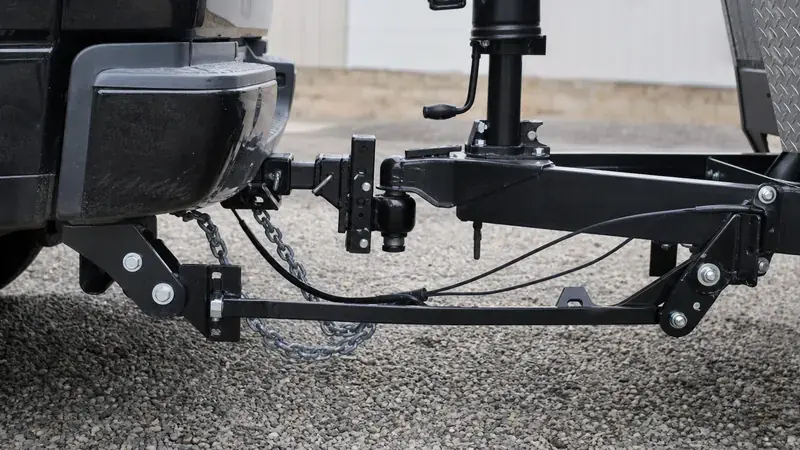
- 10 min readWeight Distribution Hitch: How It WorksHow spring bars restore front axle load, when you need one, and what it does not change.
- 13 min readTrailer Hitch Classes and Ball Sizes: What the Chart Leaves OutHitch classes are a manufacturer convention, not a standard — two makers publish Class 3 at 10,000 lb and 3,500 lb. What the class does tell you, and ball sizing.

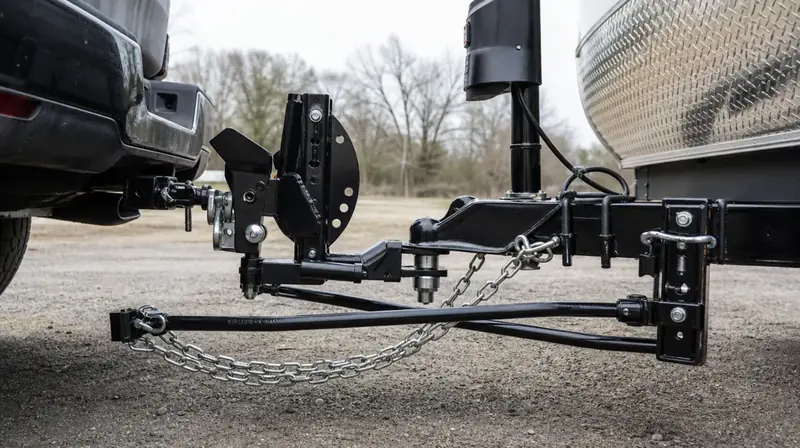
- 12 min readDo I Need a Weight Distribution Hitch? The Four TestsFour checks settle it: the receiver's two ratings, the 50% rule, how the truck sits, and your manufacturer's own threshold. Plus when not to fit one.


Other guide categories
- Ratings & CapacityWhat GVWR, GCWR, GAWR and payload each control, and how to find your real numbers.
- Payload & Tongue WeightThe limit that binds first on most family setups, and how to budget for it.
- Can I Tow It?Worked answers for a specific truck or SUV paired with a specific trailer.
- Charts & ReferenceLookup tables for towing capacity, payload, tongue weight and trailer weights.
- Laws & ComplianceTrailer brake, breakaway and safety-chain rules, sourced to each state's statute.
- Driving & TechniqueHitching, speed and spacing, corners, hills, sway, reversing and parking.