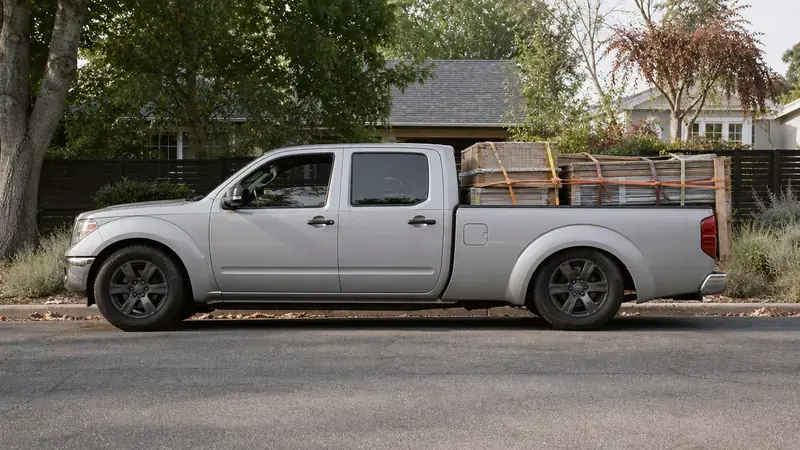
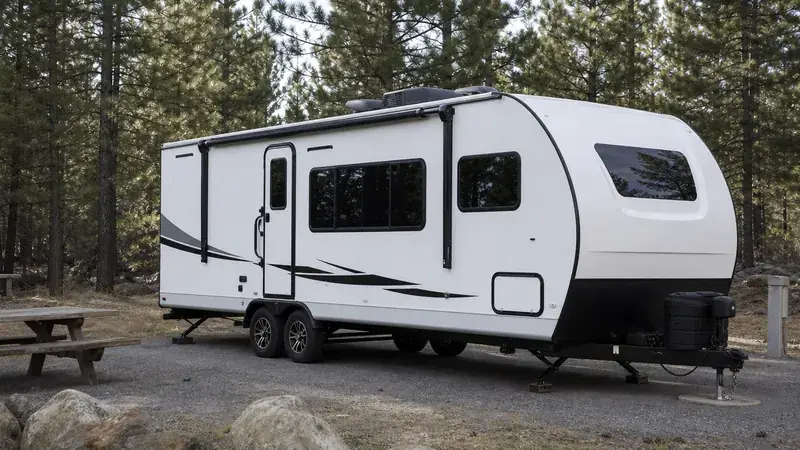
Pickup truck towing an RV travel trailer through the mountains at sunset
Free Towing Capacity Calculator

Know exactly what your truck can tow β€” before you hit the road.

Calculate GVWR, GCWR, payload, and trailer weight in one place. Built for RVers, truck owners, and weekend adventurers who tow smart and safe.

Tow status
Enter your specs to begin
01

Truck Specs

Find these on your driver-door sticker or owner's manual.

*Always verify with physical safety door jamb labels.Browse Specs Database β†’
lbs

Gross Vehicle Weight Rating

lbs

Gross Combined Weight Rating

lbs
lbs

GVWR βˆ’ Payload capacity

lbs

GCWR βˆ’ GVWR (assumes payload is at max)

02

RV / Trailer Specs

From the trailer's data plate or brochure.

lbs
lbs

Gross Vehicle Weight Rating

lbs

Typically 10–15% of total loaded trailer weight

03

Truck GVWR & Payload

Everything riding in the cab and bed.

lbs
lbs
lbs

Passengers + Cargo

lbs

Entered above in RV specs

lbs

Total payload + Hitch weight

lbs

Negative means truck is overloaded.

β€” Enter specs
04

RV GVWR & Payload

Add everything you'll load into the RV.

lbs

Entered above in RV specs

lbs

1 gallon of water = 8.35 lbs

lbs

Verify if already included in RV dry weight

lbs

Verify if already included in RV dry weight

lbs
lbs
lbs

Dry weight + all cargo

lbs

Entered above in RV specs

lbs

Negative means RV is overloaded.

β€” Enter specs
05

GCWR and Tow Capacity

lbs

Truck curb weight + truck payload + RV gross weight estimate

lbs

GCWR βˆ’ GCWR Hitched. How much more you could tow, in theory.

β€” Enter specs

How the towing calculator works

A safe tow setup respects three ratings: GVWR (the truck), GVWR (the trailer), and GCWR (truck + trailer combined). Exceeding any of them stresses your brakes, suspension, and drivetrain β€” and can void insurance.

1. Enter truck ratings

GVWR, GCWR, and payload β€” all printed on your driver-door sticker.

2. Add RV specs

Dry weight, trailer GVWR, and hitch (tongue) weight from the trailer plate.

3. Load it up

Passengers, cargo, water, propane, gear β€” anything you add changes the math.

Frequently asked questions

What is towing capacity?

Towing capacity is the maximum weight your vehicle can safely pull behind it, as determined by the manufacturer. However, the brochure number is an ideal maximum that assumes a completely empty truck with only a 150-pound driver. Under the SAE J2807 trailering standards, this base rating assumes minimal optional features.

The True Formula:

True Towing Capacity = GCWR βˆ’ Actual Loaded Weight of Tow Vehicle

To find your real towing capacity, you must subtract the actual weight of your loaded truck (including passengers, gear, cargo, hitches, and tools) from your truck's GCWR (Gross Combined Weight Rating). As you add weight to your truck, your tow capacity drops pound-for-pound.

What's the difference between GVWR and GCWR?

These two ratings govern different aspects of your towing setup, in compliance with NHTSA Towing safety regulations:

  • GVWR (Gross Vehicle Weight Rating): The maximum legal and safe limit that a single vehicle can weigh on its own tires when fully loaded. This applies to both the truck and the trailer individually. It includes the vehicle itself, fuel, passengers, cargo, and tongue/pin weight pressing down on the hitch.
  • GCWR (Gross Combined Weight Rating): The maximum combined weight of the entire rig. This is the absolute limit for the loaded tow vehicle and the loaded trailer added together. It is determined by the engine, transmission, brakes, and frame capacity.
Why does hitch weight count against my truck's payload?

When you hitch a trailer to your truck, the trailer's front weight rests entirely on the truck's hitch ball or fifth-wheel receiver. This vertical downward force is called tongue weight (for bumper pulls) or pin weight (for fifth wheels), which is formally governed under standard NHTSA Towing Guidelines.

Because this weight is fully supported by the truck's suspension, axles, and tires, it acts exactly like cargo placed in the truck bed. Therefore, you must subtract this hitch weight from your truck's total payload capacity. For example, if your truck has a payload capacity of 1,800 lbs and your trailer's tongue weight is 800 lbs, you only have 1,000 lbs remaining for passengers, pets, tools, and gear inside the truck.

How accurate is this towing calculator?

The calculations are mathematically precise based on standard industry formulas, but the accuracy of the output relies entirely on the numbers you input. Manufacturer brochures and online guides often list "dry" or "base" weights that do not account for optional packages, dealer-installed accessories, or your gear.

To ensure maximum safety, always verify your truck's specifications using the yellow and white Tire and Loading Information sticker inside the driver-side door jamb. For the absolute ultimate accuracy, we highly recommend taking your fully loaded rig (full water, full fuel, all passengers, and gear) to a certified CAT Scale network location for three-point weighing.

What is Payload Capacity and why is it usually the first limit exceeded?

Payload capacity is the maximum weight a vehicle can carry in and on itself. This includes the weight of the driver, passengers, aftermarket accessories (like bed liners, steps, or heavier tires), cargo, fuel, and the tongue or pin weight of your trailer. Under FMCSA vehicle weight limits, exceeding rated payload represents an immediate vehicle operating hazard.

Why it is the bottleneck: Most truck owners focus on the high "Towing Capacity" advertised in commercials (e.g., 10,000 lbs). However, a 10,000-lb trailer will generate 1,000 to 1,500 lbs of tongue weight. If your half-ton truck has a payload capacity of only 1,600 lbs, after subtracting the tongue weight, you are left with just 100 to 600 lbs for passengers and gear. A family of four plus a dog will instantly overload the truck, even though the trailer is well under the advertised tow capacity.

What is the 80% Rule in towing, and is it a hard law?

The 80% Rule is a widely recommended safety guideline advising that you should never exceed 80% of your vehicle's maximum rated towing and payload capacities. It is not a legal requirement, but rather a conservative engineering margin of safety often supported in Federal highway safety studies.

Why tow at 80% capacity?

  • Mountain driving: High altitude reduces engine performance (about 3-4% loss per 1,000 feet for naturally aspirated engines).
  • Weather conditions: Strong crosswinds and rain require much higher steering control and vehicle stability.
  • Wear and tear: Operating at 100% capacity puts extreme stress on your transmission, engine cooling system, brakes, and suspension, accelerating mechanical fatigue.
What is Tongue Weight vs. Pin Weight?

Both terms refer to the vertical force that the trailer exerts on the tow vehicle, but they apply to different hitch styles in standard NHTSA conventional towing guidelines:

  • Tongue Weight (Bumper Pull): The downward force exerted on the hitch ball by a standard travel trailer, utility trailer, or boat. For safe towing, conventional trailers require 10% to 15% of their total loaded weight to rest on the tongue. Too little tongue weight causes trailer sway; too much overloads the rear axle.
  • Pin Weight (Fifth Wheel / Gooseneck): The downward force exerted on the fifth-wheel kingpin or gooseneck ball inside the truck bed. Because these hitches sit directly over or slightly ahead of the truck's rear axle, they can handle higher ratios, typically 15% to 25% of the loaded trailer weight. This centered weight greatly improves stability and reduces sway.
Where exactly can I find my truck's actual weight ratings?

Do not rely on brochures, commercials, or general website charts. To find your vehicle's unique ratings, look for two key decals on the driver's side door pillar (B-pillar) or the door edge, or use resources like the official Ford Support center or RAM Towing portal:

  1. Tire and Loading Information Sticker (Yellow/White): This contains the critical warning: "The combined weight of occupants and cargo should never exceed XXXX kg or XXXX lbs." This is your truck's specific payload capacity as it left the factory.
  2. Federal Certification Label (Silver/Black): This sticker lists your vehicle's GVWR (Gross Vehicle Weight Rating), and GAWR (Gross Axle Weight Rating) for both Front and Rear axles.

Note: To find your GCWR (Gross Combined Weight Rating), refer to your truck's owner's manual under the towing section, matching your exact engine, rear axle ratio, and cab configuration.

What is GAWR (Gross Axle Weight Rating) and why does it matter?

GAWR (Gross Axle Weight Rating) is the maximum weight that a single axle assembly (either front or rear) can safely support under FMCSA axle weight limits. It is divided into Front GAWR (FGAWR) and Rear GAWR (RGAWR).

Even if your total vehicle weight is below the GVWR, you can still exceed the RGAWR. When towing a conventional bumper-pull trailer, the hitch acts as a lever behind the rear axle. The tongue weight pulls down on the hitch, which actually lifts weight off the front axle and transfers it, along with the tongue weight, onto the rear axle. This can easily overload your rear tires, suspension, or axle bearings. Always check individual axle weights on a scale.

How does a Weight Distribution Hitch (WDH) work, and does it increase towing capacity?

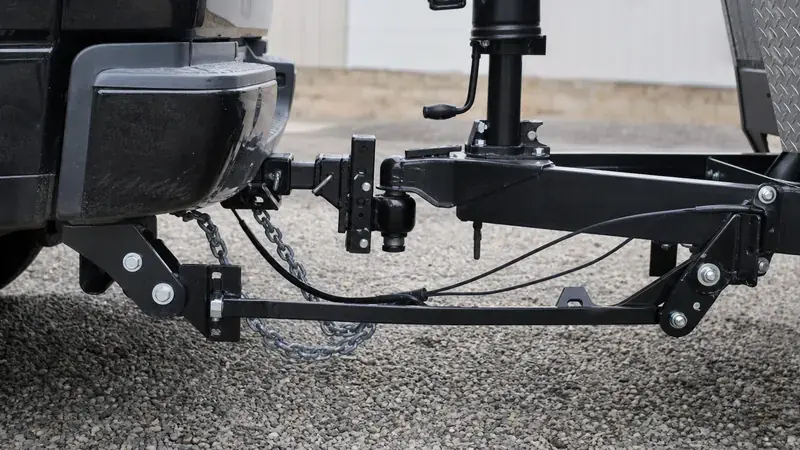
A Weight Distribution Hitch (WDH) uses spring bars and leverage to distribute a portion of the trailer's tongue weight off the truck's rear axle and transfer it forward to the truck's front axle, as well as backward to the trailer's axles, aligned with the Society of Automotive Engineers (SAE) rules on chassis balance.

CRITICAL TRUTH: A WDH does NOT increase your truck's towing capacity or payload ratings.

It only restores balance, steering control, and front-braking traction by preventing the truck's rear suspension from sagging. It makes towing safer and more comfortable, but you must still adhere to the truck's original door-sticker limits.

What is Trailer Sway, and how do I prevent or stop it?

Trailer sway is the dangerous fish-tailing side-to-side movement of a trailer. It is primarily caused by high winds, passing semi-trucks, excessive speed, or improper weight distribution, which is a major focus of U.S. Department of Transportation (DOT) cargo securement safety audits.

How to prevent sway:

  • Ensure 10-15% Tongue Weight: Heavy items must be loaded in the front of the trailer. If the back is too heavy, the trailer will sway violently.
  • Install a Sway Control Device: Use a weight-distribution hitch with integrated dual-cam or friction sway control.

What to do if sway starts:

Do NOT hit the truck's brakes or turn the steering wheel. Instead, keep the truck driving straight, let off the accelerator, and manually activate the trailer's electric brakes using the slide bar on your in-cab brake controller to pull the trailer back into alignment.

How does altitude affect my truck’s engine performance and towing limits?

As elevation increases, the air becomes thinner (less dense). For naturally aspirated (non-turbo) gas engines, this results in a power loss of approximately 3% to 4% for every 1,000 feet of elevation above sea level, as documented in powertrain guidelines from Ford.

For example, driving at Eisenhower Pass in Colorado (11,000 ft) will cause a naturally aspirated truck to lose nearly 35-40% of its engine horsepower. While turbocharged and diesel engines handle altitude much better by adjusting boost, they still face thermal limits. Manufacturers generally recommend derating your towing GCWR by 2% per 1,000 feet of elevation to avoid straining your powertrain and cooling system.

What is the difference between Dry Weight and Cargo Carrying Capacity (CCC)?

These two terms define how much weight you can safely load into your trailer under the guidelines of the Recreation Vehicle Industry Association (RVIA):

  • Dry Weight (UVW - Unloaded Vehicle Weight): The weight of the trailer as built by the factory. Crucially, this does not include water in the tanks, LP (propane) in the cylinders, batteries installed by the dealer, or any personal cargo.
  • Cargo Carrying Capacity (CCC): The maximum weight of fresh water, propane, gear, food, and options you can add. The formula is: CCC = Trailer GVWR βˆ’ Unloaded Vehicle Weight (UVW) βˆ’ LP Gas Weight βˆ’ Fresh Water Weight.

Always base your towing calculations on the trailer's GVWR rather than its dry weight, as you will almost never tow a completely empty trailer.

How does carrying fresh water affect my trailer's balance and towing?

Water is extremely heavy, weighing 8.34 lbs per gallon. If your trailer has a 50-gallon fresh water tank, filling it adds 417 lbs of cargo weight to your trailer, as calculated in our Payload capacity safety calculator.

Where this tank is located makes a huge difference: if the water tank is positioned forward of the trailer axles, filling it will dramatically increase your tongue weight. If the tank is behind the axles, it will decrease your tongue weight, which could trigger trailer sway. When possible, it is best to travel with empty or near-empty tanks and fill up at or near your campground.

What are the legal requirements for trailer brakes and brake controllers?

In almost all US states and Canadian provinces, trailer brakes are legally required on any trailer with a gross weight exceeding 3,000 lbs, as detailed in our comprehensive US Trailer Brake Laws by State Guide. Furthermore, in-cab brake controllers are regulated under the Federal Highway Administration (FHWA) brake guidelines.

Brake controllers are divided into two types:

  • Proportional Controllers: Highly recommended. They use inertia sensors to detect how hard the truck is braking and apply the exact same proportional braking force to the trailer instantly.
  • Time-Delay Controllers: Apply a pre-set amount of braking force after a set delay. They are cheaper but offer a rougher, less responsive braking experience.
What are ST tires vs. LT tires, and can I use light truck tires on my trailer?

Tire design is highly specialized for the demands of the vehicle. Tire loading limits and axle friction rules are defined under the Tire Rack Load Index metrics:

  • ST (Special Trailer) Tires: Engineered specifically for trailers. They feature stiffer sidewalls to handle heavy vertical loads and lateral scrubbing forces during sharp turns, and have chemicals added to resist ozone and UV aging. They are not designed for traction or steering and should never be put on passenger vehicles.
  • LT (Light Truck) Tires: Designed for trucks, SUVs, and vans. They are built for traction, braking, and steering. While some heavy-duty trailers come with LT tires from the factory, you should only use them if specifically permitted by the trailer manufacturer, ensuring the tire's load index meets or exceeds the trailer's axle rating.
What tire pressure should I run in my trailer tires?

Unlike passenger cars where tires are run at a comfortable lower PSI, ST trailer tires should almost always be inflated to their maximum cold pressure rating as indicated on the tire sidewall and in standard NHTSA trailer tire guidelines.

Under-inflating trailer tires causes the sidewalls to flex excessively under heavy loads. This flexing generates extreme heat, which is the number one cause of catastrophic trailer tire blowouts. Checking and adjusting tire pressure when tires are completely cold (before driving) is the single best preventative maintenance step you can take.

How does towing affect my vehicle's braking distance? What is the 3-second rule?

Adding a 5,000 to 10,000-lb trailer to your truck exponentially increases the kinetic energy that your brakes must convert to heat. Under standard AAA driving safety manuals, the following distance must be scaled up to secure stability.

While a 3-second following distance is recommended in dry weather for normal driving, you should increase your following distance to at least 5 to 6 seconds when towing. This provides the necessary reaction time and buffer space to bring the heavy combined rig to a controlled, safe stop without overheating your brakes or triggering a collision.

What happens mechanically if I exceed my vehicle's GCWR?

Exceeding the Gross Combined Weight Rating (GCWR) causes severe stress across your vehicle's mechanical infrastructure, exceeding engine and radiator cooling specs detailed in OEM Powertrain specs:

  • Transmission Overheating: The transmission will slip and hunt for gears, causing fluid temperatures to skyrocket. Transmission fluid breaks down quickly above 220Β°F, leading to clutch failure.
  • Engine Strain & Cooling Failure: Your radiator, engine block, and cooling fans will be unable to dissipate heat fast enough, leading to blown head gaskets or warped cylinders.
  • Brake Fade: Overworked brakes will experience thermal gas release (brake fade), meaning the pedal will feel soft and the truck will lose its stopping ability entirely.
  • Frame & Suspension Fatigue: Overloading can crack or bend steel frame rails and cause leaf springs or shocks to bottom out permanently.
Can I install airbags or helper springs to increase my truck's payload capacity?

ABSOLUTELY NOT.

Installing aftermarket helper springs, suspension air bags, Timbrens, or heavier shocks does not change your truck's certified GVWR or payload capacity ratings. These modifications only assist in leveling the truck's ride height and reducing headlight sag. Doing so violates structural chassis parameters certified under SAE engineering limits.

The original payload capacity is determined by the weakest link in your vehicle's drivetrain, frame, axle bearings, braking system, wheel studs, and tire load ratings. Adding airbags does not make your brakes larger or your axles stronger. Overloading a vehicle with helper springs still exposes you to mechanical failure and legal liability in an accident.

How do I properly adjust the brake gain on my electronic brake controller?

Properly setting your brake gain ensures the trailer stops itself without dragging down the truck or locking up, following standard NHTSA brake calibration procedures. Follow this step-by-step setup procedure in a safe, flat, paved area:

  1. Set the controller's initial gain to a middle setting (typically 5.0).
  2. Drive your truck and trailer straight forward at approximately 20 to 25 mph.
  3. Fully squeeze or press the manual emergency slide lever on the brake controller without touching the truck's brake pedal.
  4. If the trailer brakes lock up and skid, immediately release the lever, reduce the gain setting, and repeat.
  5. If the brakes do not lock up and you feel very little stopping force, increase the gain setting and repeat.
  6. Your ideal setting is just below the point where the trailer tires lock up (skid), providing aggressive, smooth braking.
What are the differences between Class III, Class IV, and Class V receivers?

Hitches are rated by classes based on the maximum weight they can safely hold and pull in accordance with standard tow ratings:

Hitch ClassMax Trailer WeightMax Tongue WeightReceiver Size
Class IIIUp to 8,000 lbsUp to 800 lbs2" x 2"
Class IVUp to 12,000 lbsUp to 1,200 lbs2" x 2"
Class VUp to 20,000+ lbsUp to 2,000+ lbs2.5" or 3"

IMPORTANT: Your system's capacity is determined by its weakest link. If you have a Class V hitch receiver but use a ball mount rated for Class III, your maximum safe towing capacity is restricted to the Class III limits (8,000 lbs).

What is the wheelbase-to-trailer length rule for stable towing?

The length of your trailer acts as a massive lever against your truck's rear wheels in crosswinds or passing trucks. Short wheelbases paired with excessive trailer length run significant instability risks on high speed roads.

Standard Wheelbase Guidelines:

  • For a 110-inch wheelbase, your maximum recommended trailer length is 20 feet.
  • For every 4 inches of additional wheelbase, you can safely increase the trailer length by 1 foot.
Max Length = 20 ft + ((Truck Wheelbase βˆ’ 110) / 4)

Following this rule prevents a "tail wagging the dog" scenario on highway driving.

What are the obvious warning signs that my vehicle is overloaded while towing?

If you experience any of these symptoms while towing, safely pull over and inspect your weights immediately:

  • Rear Suspension Sag ("Squatting"): The rear of the truck dips excessively, pointing the headlights up into the sky and lifting the front steering tires.
  • Floaty, Loose Steering: Steering feels light and unresponsive because there is insufficient weight on the front tires.
  • Slow, Spongy Braking: The brakes feel hot, smell burnt, or require excessive force to slow down.
  • Frequent Transmission Hunting: The transmission constantly shifts up and down on small grades, with rising transmission temperatures (exceeding 220-230Β°F).
  • Uncontrollable Sway: The trailer feels like it is pulling the rear of the truck side-to-side at highway speeds.
Why are trailer tire speed ratings critical, and can I drive 75+ mph?

Unlike passenger car tires which are rated for speeds over 100 mph, older ST trailer tires are historically rated for a maximum speed of only 65 mph (104 km/h).

While many modern ST tires are now built with higher speed ratings (e.g., speed symbol "N" for 87 mph or "L" for 75 mph), towing a trailer at high speeds is still dangerous. Driving faster than 65 mph increases tire friction, sidewall heat buildup, and aerodynamic drag exponentially. Furthermore, if a trailer tire blows out at 75 mph, the damage to your trailer's wheel well and plumbing can be catastrophic, and controlling the heavy rig becomes much more difficult. It is always safest to travel at 60 to 65 mph.

What is a CAT Scale, and how do I perform a "3-Pass Weigh" to get exact values?

A certified CAT (Certified Automated Truck) Scale, located at most major truck stops, is the only way to get 100% accurate, legally binding weights of your setup. Learn more and locate scales via the official CAT Scale portal, then perform a three-pass weigh:

  • Pass 1: Truck & Trailer Hitched with Weight Distribution Engaged. Drive onto the scale with the truck's front axle on platform 1, rear axle on platform 2, and trailer axles on platform 3. This gives you your active driving axle loads.
  • Pass 2: Truck & Trailer Hitched with WDH Spring Bars Disconnected. Keep the rig in the same spot, but release the tension on your WDH bars. This reveals the raw tongue weight transfer.
  • Pass 3: Truck Only (Unhitched). Drive the trailer off the scale, park it, and weigh just the truck. Front axle on platform 1, rear axle on platform 2.

Subtracting Pass 3 weights from Passes 1 and 2 allows you to calculate your precise tongue weight, total loaded trailer weight, and how much weight your WDH is successfully transferring to your front axle.

What is the difference between a bumper pull, a fifth wheel, and a gooseneck hitch?

These three hitch configurations have distinct weight ratings and handling characteristics:

  • Conventional Bumper Pull: Attaches to a receiver mounted under the rear bumper. It is the most common, affordable, and flexible setup. However, it places the pivot point far behind the rear axle, making it the most susceptible to trailer sway and leverage sag.
  • Fifth Wheel: Mounts inside the truck bed using a large plate receiver. Used almost exclusively for large RVs. Because the hitch pin sits directly over the rear axle, it offers superior stability, zero sway, and allows for higher pin weights (15-25% of trailer weight).
  • Gooseneck: Utilizes a ball hitch mounted inside the truck bed. Used mostly for commercial, agricultural, and horse trailers. Offers similar high stability and weight capacity to a fifth wheel, but leaves the truck bed mostly clear when the ball is flipped down.
What transmission gear should I use when towing uphill and downhill?

When towing in hilly or mountainous terrain, proper gear selection prevents transmission failure and brake overheating:

  • Uphill: Engage your truck's Tow/Haul Mode. This changes the shift programming, keeping the engine in its optimal power band and preventing the transmission from constantly hunting for gears, which generates heat. Manually downshift to a lower gear if engine temperatures begin to rise.
  • Downhill: Never ride or "drag" your brakes down a steep grade, as this will lead to brake fade and complete loss of stopping power. Instead, downshift the transmission manually to allow the engine's compression to slow your speed (engine braking). Use firm, brief "snub" braking on the pedal to drop your speed when needed, then let off to allow the brakes to cool.
How can I estimate the weight of my loaded trailer without a scale?

If you cannot immediately access a scale, you can build a realistic estimate of your loaded trailer weight using this structured formula:

Estimated Loaded Weight = Dry Weight + Water Weight + LP Gas Weight + Battery Weight + Cargo Weight

Calculating the components:

  • Fresh Water: Gallons Γ— 8.34 lbs (e.g., 40 gallons = 334 lbs).
  • Propane (LP): Typically 20 lbs per tank (empty weight is ~17 lbs, so loaded tank is ~37 lbs each).
  • Batteries: Deep cycle lead-acid batteries weigh ~50 to 70 lbs each (LiFePO4 are ~25 to 30 lbs).
  • Personal Cargo: The average camper packs 800 to 1,200 lbs of clothes, bedding, pots, food, camp chairs, hoses, and leveling blocks.

Caution: Real scale weights are almost always higher than manual estimates. When in doubt, assume your trailer is loaded to 90% of its GVWR.

Is triple towing (double trailers) legal, and what are the rules?

Triple towing (towing two trailers behind a single tow vehicle, such as a truck pulling a fifth-wheel camper, which in turn pulls a small boat or utility trailer) is highly restricted.

It is completely illegal in many states, particularly in the eastern US (e.g., New York, Pennsylvania, Florida). In states where it is permitted (primarily in the Midwest and West), strict regulations apply:

  • The first trailer must generally be a fifth-wheel or gooseneck trailer, not a bumper pull.
  • The total combined length of the truck and both trailers combined cannot exceed a specified length, usually between 65 and 75 feet.
  • Both trailers must have functioning brakes.

Always verify the vehicle codes of every state you plan to drive through before attempting double towing.

Why must safety chains be crossed under a bumper pull trailer coupler?

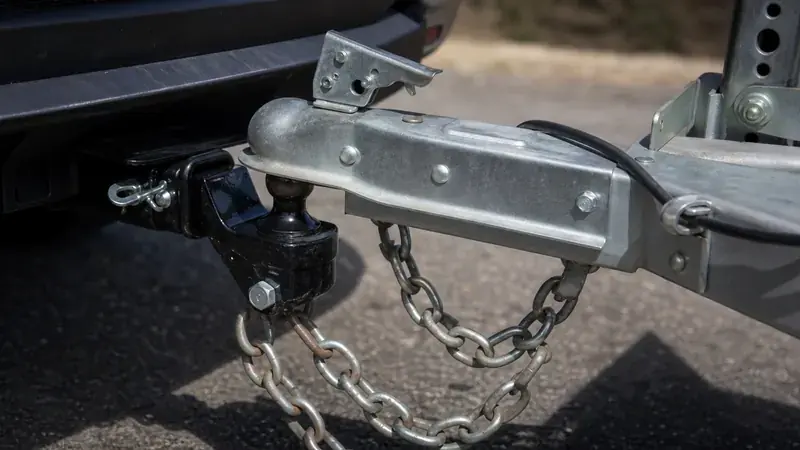
When hooking up a bumper pull trailer, you must always cross your safety chains under the trailer tongue in an "X" pattern. This is not just a convenienceβ€”it is a critical safety engineering design and a legal requirement in most states.

The Cradle Effect: If the trailer coupler pops off the hitch ball while driving, the tongue will drop down. By crossing the chains, they form a tight suspended steel cradle that catches the trailer tongue before it hits the asphalt. This prevents the tongue from digging into the road bed, which would instantly flip or jackknife the trailer.

How does excessive tongue weight affect steering and headlights?

An overloaded rear hitch acts as a pivot lever on your truck's rear axle. Excess tongue weight pulls the rear of the truck down, compressing the rear suspension. Due to leverage, this physically lifts the front of the truck upward.

This triggers two serious safety hazards:

  1. Loss of Front Traction: Weight is removed from the steering tires, causing your steering to feel light, vague, and highly unresponsive. It also reduces your front braking power, since front brakes provide up to 70% of stopping force.
  2. Blinded Traffic: The upward angle of the truck cab aims your headlights directly into the eyes of oncoming drivers, blinding them and significantly reducing your own night visibility.
What is a trailer breakaway switch and breakaway cable?

A breakaway switch is a small, key-sized box mounted on the trailer tongue with a thin steel cable running to the truck frame. It is your absolute last line of defense in a catastrophic disconnect under Federal Highway breakaway guidelines.

How it works:

The steel cable must be securely fastened to a permanent metal part of the truck frame, never looped around the hitch ball or safety chains. If the trailer fully uncouples from the truck and the safety chains fail, the trailer will separate from the truck. This pulls the metal pin out of the breakaway switch box, completing an electrical circuit. This circuit uses the trailer's onboard 12V battery to immediately apply maximum voltage to the trailer's electric brakes, locking them up to halt the runaway trailer.

How do I determine if my SUV or half-ton truck needs a weight distribution hitch?

Most automotive manufacturers require or strongly recommend a weight distribution hitch under these specific conditions:

  • The trailer weight exceeds 5,000 lbs (for light trucks and SUVs).
  • The trailer tongue weight exceeds 500 lbs.
  • The rear bumper of the tow vehicle sags more than 2 inches after hitching the trailer.
  • The front wheel wells of your vehicle measure more than 1/2-inch higher after hitching the trailer compared to their unhitched height.

Check the towing section of your vehicle's owner's manual. Most half-ton trucks (F-150, Silverado 1500, Ram 1500) have receiver stickers that specify a lower weight limit (e.g., 5,000 lbs) for "Weight Carrying" (bumper pull without WDH) and a higher weight limit (e.g., 10,000+ lbs) for "Weight Distributing".

The complete reference

The complete towing guide: power, payload, safety, laws and accident prevention

A 10,000+ word deep dive into everything that determines whether a tow goes smoothly or ends on the shoulder. Built for first-time RVers, contractors, horse haulers, boat owners, and anyone who's ever stared at a driver-door sticker and wondered what those numbers actually mean.

1. Truck power and drivetrain: what actually pulls the load

Before you ever touch a calculator, it helps to understand what's happening under your hood when a fully loaded trailer is hooked to the back of your truck. Towing is not just a matter of "horsepower." It's the result of an entire drivetrain β€” engine, transmission, axles, cooling system, frame, and brakes β€” working in coordinated tension against the mass behind it. A truck with the wrong drivetrain for the load will burn up its transmission, glaze its brake pads, and overheat its engine long before it runs out of horsepower on paper.

The two numbers manufacturers love to quote are horsepower and torque. Horsepower is a measure of how fast work can be done; torque is a measure of how much rotational force the engine produces. For towing, torque is the number that matters most, because torque is what gets a heavy load moving from a dead stop, climbs you up a grade, and lets you accelerate onto a freeway on-ramp without becoming a hazard. A diesel pickup making 1,000 lb-ft of torque at 1,600 rpm will out-tow a gas truck rated at 450 horsepower but only 410 lb-ft of torque, because the diesel delivers its grunt at the rpm where you actually drive.

Gas engines versus diesel engines for towing

Gas engines, especially modern turbocharged V8s and the new generation of high-output V6s, have closed the gap with diesels for light and moderate towing. They're cheaper to buy, cheaper to maintain, lighter (which actually helps payload), and quieter. For trailers under roughly 10,000 lbs and short, infrequent trips, a well-spec'd gas half-ton or three-quarter-ton truck is often the right answer. The downsides show up when the load gets heavy, the grade gets long, or the trips get frequent: gas engines have to spin harder to make their power, which means lower fuel economy, more heat in the transmission, and faster wear.

Diesel engines, by contrast, are built around low-rpm torque. A modern 6.7L diesel in a three-quarter or one-ton truck produces 900 to 1,100 lb-ft of torque between 1,500 and 2,800 rpm β€” exactly where a tow vehicle lives on the highway. Diesels also benefit from compression ignition, which is more thermodynamically efficient than spark ignition, so fuel economy while towing is meaningfully better. They cost more upfront (often $9,000 to $12,000 more than the comparable gas engine), require diesel exhaust fluid, and have more expensive scheduled maintenance β€” but for anyone towing heavy trailers regularly, the long-term math usually favors the diesel.

Transmissions, gearing and rear axle ratio

The transmission and the rear axle ratio quietly determine half of your truck's true towing capability. A 10-speed automatic with closely spaced ratios will keep the engine in its torque sweet spot whether you're crawling out of a campsite or cruising at 70 mph. A 6-speed in the same truck will hunt between gears on grades, generate more heat, and shorten transmission life.

The rear axle ratio is the gear ratio between the driveshaft and the rear wheels. A numerically higher ratio (for example, 4.10 versus 3.55) multiplies torque more, improving acceleration and pulling power at the cost of highway fuel economy. For towing, most manufacturers offer a "max tow" or "heavy duty" axle ratio that's worth ordering if you know you'll be pulling near the truck's rated capacity. A truck with a tall (numerically low) axle ratio bought purely for unloaded fuel economy will struggle and overheat under sustained towing loads even if the spec sheet says it can handle the weight.

Cooling: the unsung hero of towing capacity

Heat is what kills tow vehicles. Engine oil, coolant, transmission fluid, differential oil, and even the air entering the turbocharger all rise dramatically in temperature when you're dragging weight up a 6% grade in 95-degree weather. This is why factory "Max Tow" or "Heavy Duty Tow" packages always include a larger radiator, a transmission cooler, a power steering cooler, and frequently a higher-output alternator. These aren't marketing β€” they're the difference between making it to the top of the pass and coasting onto the shoulder with a check-engine light. If you tow regularly and your truck didn't come with these from the factory, retrofitting an aftermarket transmission cooler is one of the highest-value upgrades you can make.

2. Towing fundamentals: every weight rating, decoded

Almost every towing accident traces back to a misunderstanding of three or four numbers that are stamped on a sticker most owners never read. Let's walk through them one by one, in plain language, with examples.

GVWR β€” Gross Vehicle Weight Rating

GVWR is the maximum total weight a single vehicle is allowed to weigh while loaded. That's the vehicle itself, fuel, passengers, cargo, and anything pressing down on the hitch. Your truck has a GVWR. Your trailer has its own, separate GVWR. Exceeding GVWR puts you over the structural and braking limits the manufacturer engineered the vehicle to handle. It's not a "soft" number; it's a federal safety standard.

Example: a Ford F-250 with a GVWR of 10,000 lbs and a curb weight of 7,500 lbs has 2,500 lbs of legal payload. Two adults, two kids, a full tank of diesel, a tonneau cover, a bed-mounted toolbox, and the tongue weight of the trailer all count against that 2,500 lbs.

GCWR β€” Gross Combined Weight Rating

GCWR is the maximum allowable combined weight of the tow vehicle and the trailer, loaded, hitched together, with everything inside both of them. This is the single most-violated number in towing. People look at the "tow rating" on the brochure, subtract the trailer's dry weight, and assume they're fine. But GCWR caps the whole combination, and as you add cargo, water, propane, and passengers to either side, the combined number creeps up faster than people expect.

Payload capacity

Payload is the carrying capacity of the tow vehicle alone. It equals GVWR minus curb weight. It includes everything you add to the truck after it leaves the factory β€” and critically, it includes the trailer's tongue weight or pin weight, which presses down on the hitch and onto the truck's rear axle.

Tongue weight and pin weight

For a conventional (bumper-pull) trailer, the downward force at the hitch ball is the tongue weight, typically 10 to 15% of the loaded trailer weight. For a fifth-wheel or gooseneck trailer, the downward force on the truck bed is the pin weight, which is usually 20 to 25% of loaded trailer weight. Tongue and pin weight count against payload, not towing capacity. A 12,000 lb fifth-wheel can easily put 3,000 lbs of pin weight in the bed of your truck β€” which can blow through the payload of even a stout three-quarter-ton pickup once passengers and gear are added.

Towing capacity vs. usable towing capacity

The "towing capacity" advertised in glossy brochures is the absolute manufacturer maximum, calculated using SAE J2807 with a single 150-lb driver, a full tank of fuel, and no cargo. Your real-world usable towing capacity is almost always lower. Subtract passengers, cargo, fuel for accessories, and your hitch hardware, and the number that actually matters is what's left over.

GAWR β€” Gross Axle Weight Rating

Each axle has its own maximum weight rating: front GAWR and rear GAWR. Even if you're under GVWR overall, you can overload a single axle β€” most commonly the rear axle of a tow vehicle carrying a heavy hitch. The only way to know for sure is to weigh each axle at a CAT scale.

AcronymStands forWhat it limits
GVWRGross Vehicle Weight RatingTotal loaded weight of a single vehicle
GCWRGross Combined Weight RatingTotal combined weight of truck + trailer
GAWRGross Axle Weight RatingMax load on a single axle
GTWGross Trailer WeightActual loaded weight of the trailer
TWTongue WeightDownward force at the hitch ball (bumper-pull)
PWPin WeightDownward force on truck bed (fifth-wheel/gooseneck)
UVWUnloaded Vehicle WeightTrailer weight from the factory (no cargo)
CCCCargo Carrying CapacityHow much cargo a trailer can hold (GVWR βˆ’ UVW βˆ’ options)

3. Hitch systems: choosing the right connection

A hitch is rated for two numbers: gross trailer weight and tongue weight. Hitches are divided into five "classes" based on capacity, and choosing the right class is non-negotiable.

ClassReceiver sizeMax GTWMax tongue weightTypical use
I1.25"2,000 lbs200 lbsBike racks, very small trailers
II1.25"3,500 lbs350 lbsSmall utility trailers, jet skis
III2"8,000 lbs800 lbsMid-size trailers, small boats, popups
IV2"10,000 lbs1,000 lbsLarge travel trailers, car haulers
V2.5" or 3"20,000+ lbs2,700+ lbsHeavy commercial, large fifth-wheels (via gooseneck adapter)

Bumper-pull (conventional) hitches

The most common setup: a receiver mounted to the truck frame accepts a removable drawbar, which holds a ball that the trailer's coupler latches onto. Simple, inexpensive, and adequate for trailers up to about 10,000 lbs when matched with a weight-distribution system.

Weight-distribution hitches

For any conventional trailer over about 5,000 lbs (or when the tongue weight exceeds roughly 10% of your truck's rear GAWR margin), a weight-distribution hitch (WDH) is either required or strongly recommended. A WDH uses spring bars to redistribute tongue load from the rear axle of the truck back onto the front axle of the truck and forward onto the trailer's axles. The result is a level rig, restored steering feel, restored headlight aim, and dramatically better handling. Many modern truck manufacturers actually require a WDH above a certain tongue weight for the published tow rating to apply.

Fifth-wheel hitches

A fifth-wheel hitch lives in the bed of a pickup, like the kingpin coupling on a tractor-trailer. It places trailer weight directly over the truck's rear axle (instead of behind it), which is mechanically far more stable for heavy loads. Fifth-wheel hitches are the standard for travel trailers above roughly 12,000 lbs and for most large RVs. They sacrifice bed space but offer better handling and higher capacity.

Gooseneck hitches

A gooseneck uses a ball mounted in the truck bed (rather than a fifth-wheel coupler) and is most common on agricultural, livestock, and construction trailers. It frees up more bed space than a fifth-wheel and supports very heavy loads β€” often 30,000 lbs or more β€” but provides slightly less ride comfort.

Pintle hitches

Common on military, construction, and heavy commercial equipment. A pintle hook on the truck mates with a lunette ring on the trailer. Extremely tough, extremely high capacity, very forgiving of misalignment β€” but bouncy and noisy. Not used on RVs.

4. Trailer brakes and brake controllers

Your truck's brakes are sized to stop the truck. They are not sized to stop the truck plus a 7,000-lb trailer. Federal regulations and every state law require trailer brakes above certain weights (commonly 3,000 lbs gross trailer weight, though it varies by state β€” see the laws section below). Even where they're not legally required, trailer brakes are the single most important upgrade for towing safely.

Electric drum brakes

The most common type on RVs and utility trailers. A magnet in each drum is energized by the brake controller in the truck; the magnet pulls the brake shoes against the drum. Inexpensive, easy to service, and adequate for most applications. They do fade under repeated heavy use and don't perform well when wet.

Electric-over-hydraulic brakes

A small electric pump on the trailer is triggered by the truck's brake controller, but it actuates hydraulic disc brakes on the trailer. You get the responsiveness and fade-resistance of disc brakes with the convenience of an electric trailer connection. Standard equipment on most premium fifth-wheels and increasingly common on travel trailers.

Surge brakes

A purely mechanical system, common on boat trailers. When the truck slows, the trailer's coupler compresses against the hitch, hydraulically actuating the trailer's brakes. No electrical connection required, which is ideal for trailers that get dunked in salt water. The downside: no manual override from the cab, and the brakes only engage when the truck is already braking β€” making them less effective for proactive control of trailer sway.

Brake controllers: time-delayed vs. proportional

A brake controller is the device in your truck that tells the trailer brakes how hard to apply. Time-delayed controllers apply trailer brakes at a fixed, ramp-up rate whenever you touch the truck's brake pedal β€” cheap, but jerky and imprecise. Proportional (also called inertia-based) controllers use an accelerometer to sense how hard you're actually braking and apply trailer brakes in proportion. Always buy proportional. Many modern trucks have an integrated brake controller built into the dash from the factory β€” this is the gold standard.

5. Tires, wheels and load ratings

The single point of contact between your rig and the road is six to ten patches of rubber the size of your hand. The vast majority of trailer blowouts trace to overloaded tires, underinflated tires, or aged-out tires β€” all of which are within the driver's control.

Reading the sidewall

Every tire is marked with a load index and a speed rating. The load index is a number (commonly 95 to 130 for tow rigs) that maps to a maximum load in pounds. The speed rating is a letter (commonly L, M, N for trailer tires; S, T, H for passenger tires) that defines the maximum sustained speed the tire is rated for.

You'll also see a service description like "LT265/70R17 121/118S" β€” this is a Light Truck (LT) tire, 265 mm wide, 70% aspect ratio, radial construction, 17-inch wheel, load index 121 single / 118 dual, speed rating S (112 mph). Trailer-specific tires are marked "ST" (Special Trailer). Never put passenger-car "P" tires on a trailer.

Trailer tire speed ratings

A surprising number of ST-rated trailer tires are only certified to 65 mph. Driving 75 mph on the freeway with 65-mph tires is the fastest path to a blowout that exists in towing. Either keep speeds at or below your tire's rating, or upgrade to higher-speed- rated tires (many "ST" tires now come in 75 and 81 mph variants, and modern LT-rated options go higher still).

Tire age

Trailer tires age out before they wear out. The DOT date code on the sidewall is a four-digit number β€” the first two digits are the week, the last two are the year. A tire marked "3219" was made in week 32 of 2019. Most manufacturers recommend replacing trailer tires at 5 to 7 years regardless of tread depth, because UV exposure and ozone break down the rubber from the inside out. A trailer that's been sitting in a driveway for three years has aged tires even if the tread looks brand new.

Inflation pressure

Run trailer tires at the maximum cold pressure stamped on the sidewall unless the manufacturer's load/inflation chart says otherwise for your actual axle load. Under- inflation builds heat, which is the immediate cause of most blowouts. A TPMS (tire pressure monitoring system) with sensors on every trailer tire is one of the smartest $200 you'll ever spend.

6. Suspension and weight distribution

A loaded trailer changes your truck's geometry. The rear sags, the front lifts, the headlights point at the trees, the steering goes light, and the front brakes do less work because they have less weight on them. Every one of these changes is dangerous.

Weight-distribution hitch setup

When properly set up, a weight-distribution hitch should restore your truck to roughly the same ride height it had before the trailer was hooked up. Procedure:

  1. Park truck and trailer on level ground, both unhitched.
  2. Measure the height of the front fender wells above the ground. Write it down.
  3. Hook up the trailer but don't yet engage the spring bars.
  4. Measure front and rear fender heights again. The front will be higher, rear lower.
  5. Engage the spring bars at the recommended chain link or L-bracket position. Re-measure.
  6. Goal: front fender height returns to within Β½ inch of the original unhitched measurement. Adjust spring-bar tension up or down until this is achieved.

Sway control

Most modern weight-distribution hitches include integrated friction or cam-based sway control. For larger trailers, dual-cam sway control (Reese, Equal-i-zer) provides dramatic improvement over single friction bars. Sway control is not optional for high-profile travel trailers β€” it's the difference between a relaxed drive and white knuckles every time a semi passes.

Air bags and helper springs

Aftermarket air bags between the truck frame and rear axle don't increase GVWR or payload β€” but they do level the truck, restore steering geometry, and reduce squat under heavy tongue or pin loads. Highly recommended for fifth-wheel and gooseneck setups, and a good idea for any half-ton truck pulling a heavy bumper-pull trailer.

7. Pre-trip inspection: the 12-point safety check

Commercial truck drivers do a pre-trip inspection before every single trip. So should you. Every blowout, brake failure, and trailer disconnection has warning signs an attentive owner can catch in five minutes.

  1. Coupler latched and pinned: Visually confirm the coupler is fully seated on the ball, the latch is closed, and the safety pin or padlock is through the latch.
  2. Safety chains crossed and connected: Crossed under the tongue so they catch the tongue if it drops. Enough slack to turn, not so much they drag.
  3. Breakaway cable connected: The trailer's emergency breakaway switch cable connects to the truck (not to the safety chain or the ball mount). If the trailer detaches, the cable yanks the pin, the trailer's brakes apply automatically.
  4. Electrical plug connected: Test running lights, brake lights, turn signals, and the trailer brake controller indicator. Have a partner watch from behind.
  5. Tires (truck and trailer): Pressure checked cold to spec, tread depth adequate, no sidewall cracks, no objects embedded, date codes within service life.
  6. Wheel lug nuts torqued: Especially on a new trailer or after any wheel work. Re-torque after the first 50 miles.
  7. Wheel bearings: Hub temperatures should be roughly even after a brief drive. A hot hub means a failing bearing β€” pull over immediately.
  8. Brakes (manual test): At low speed in a safe area, apply the manual override on the brake controller. You should feel the trailer brakes engage before the truck slows.
  9. Mirrors adjusted: Tow mirrors extended and aimed so you can see the full length of the trailer down to the rear wheels.
  10. Cargo secured inside trailer: Refrigerator doors latched, cabinets closed, slides retracted, antenna down, awning latched.
  11. Hitch jack fully retracted: Sounds obvious. People forget. The scrape of a jack on the highway is a sound you only need to hear once.
  12. Wheel chocks removed: Equally obvious, equally embarrassing.

8. Driving technique while towing

Towing is not "driving with a heavy thing behind you." It's a fundamentally different activity that uses different reflexes, different distances, and different lane discipline. The good news is the technique is learnable in a few weekends. The bad news is most new tow drivers learn it the hard way.

Speed

Most states cap towing speeds below the standard limit β€” California is famously 55 mph for any vehicle towing. Even where the law allows 75, the smart number is rarely above 65. Wind resistance grows with the square of speed, fuel economy collapses above 65, and tire heat builds catastrophically above the tire's rated speed.

Following distance

The standard "two-second rule" assumes a car. For a loaded tow rig, count to six seconds minimum between you and the vehicle ahead. In rain or on downgrades, double it. You need roughly twice the stopping distance of an unloaded vehicle, and that's after the brake-system reaction time of the trailer brake controller.

Lane discipline

Stay in the right lane on the freeway except to pass, and signal earlier and longer than you would in a car. Other drivers misjudge how long it takes you to change lanes, because they're used to cars that can dart. Telegraph everything: signal at least three seconds before any lane change, hold the signal through the move.

Curves and turns

Trailers track inside the path of the tow vehicle (called "off-tracking"). For sharp turns β€” especially right turns β€” swing wider than feels natural and watch your trailer tires in your mirror. Cutting a turn tight will put the trailer's tires up over the curb at best, into a fire hydrant at worst.

Crosswinds and big-rig wake

When a semi passes you on the freeway, you'll feel a "push" (compression bow wave) followed by a "pull" (the low pressure behind the cab). Don't fight it with the wheel β€” small steering corrections only. The rig will settle on its own within a second or two. Death-gripping the wheel and oversteering is what starts sway.

9. Backing, parking and tight maneuvers

Backing a trailer is the skill that humbles new owners the fastest. The geometry is counterintuitive: to make the trailer go right, you turn the steering wheel left, and vice versa.

The hand-on-the-bottom-of-the-wheel trick

Place one hand on the bottom of the steering wheel. Now, whichever direction you push your hand, the back of the trailer goes. Push your hand right, the trailer goes right. Push it left, the trailer goes left. This single trick eliminates the mental reversal that trips up new drivers.

Small inputs, then straighten

Make small steering inputs, then quickly straighten the wheel once the trailer begins to respond. Over-steering is the universal beginner mistake β€” the trailer takes a beat to react, the driver doubles down, and the trailer jackknifes.

Use a spotter β€” and agreed-upon hand signals

Decide in advance which way the spotter's hand wave means. The classic mistake: spotter waves left, driver thinks the spotter wants them to go left, when the spotter actually meant the trailer needs to go left (which requires steering right). Decide together before you start.

Pull-through campsites

When choosing a campsite, pay for the pull-through. The $5 to $10 surcharge buys you out of forty-five minutes of stress, three pulled muscles, and one minor argument with your spouse. After your tenth trip you can graduate to back-in sites.

10. Mountain driving and grade descents

Mountain passes are where towing trips go from "I've got this" to "we should pull over." The right techniques aren't intuitive, but they're simple once you learn them.

Climbing grades

Let the transmission downshift, watch your coolant and transmission temperatures, and don't be a hero. If a sign says "trucks use right lane," that's you. Pull over in a legal pullout if you're forming a long line of traffic β€” it's both polite and required in most states (typically when five or more vehicles are behind you).

Descending grades: engine braking, not service brakes

The single most dangerous moment in towing is a long downgrade after you've cooked your brakes. The rule is: descend in the gear you would have climbed in. On a 6% downgrade, that's usually 3rd or 4th gear on a modern 10-speed automatic. Let the engine and transmission do the braking. Tap the service brakes briefly to slow from, say, 50 to 45 mph, then release and let engine braking hold the speed. Then tap again. Never ride the brakes continuously on a long descent.

Continuous brake application heats the brake pads, rotors, and drums until they glaze, fade, and finally fail. Once they fade, they don't come back until they cool β€” and you don't get to choose when that happens.

Tow-haul mode and exhaust brakes

Every modern tow vehicle has a "tow-haul" or "trailer" mode. Turn it on whenever a trailer is attached. It changes shift points to hold lower gears longer, adds engine braking on deceleration, and on diesels enables the exhaust brake. Use it.

Runaway truck ramps

They exist for a reason. If your brakes are smoking, your trailer is pushing you down the hill faster than the engine can hold, and you see a runaway ramp ahead β€” take it. You'll have an expensive tow bill, you'll be embarrassed, and you'll be alive.

11. Weather, wind and night towing

Tall, light trailers β€” travel trailers especially β€” are essentially sails on wheels. A 25 mph crosswind makes a meaningful difference. A 40 mph crosswind is genuinely dangerous and often a reason to stop driving. Cargo trailers and enclosed haulers are slightly better; flatbeds with low loads are the most stable. Boats on trailers can catch wind in unexpected ways.

Crosswind technique

Reduce speed substantially. A gust that's an annoyance at 65 mph is controllable at 55 and barely noticeable at 45. Add steering input as needed, but make it small and smooth. If gusts become severe enough that the trailer is moving in your lane between gusts, stop driving and wait it out.

Rain and wet roads

Stopping distance increases dramatically with weight, and trailer tires lose grip before truck tires do (because they're loaded closer to their limit). Double your following distance, halve your speed in standing water, and avoid the temptation to use cruise control β€” hydroplaning while cruise control is engaged is how trailers jackknife.

Snow and ice

Towing on snow or ice is a fundamentally different activity that requires four-wheel- drive, properly rated trailer tires (or chains), and a great deal of patience. If you don't have to tow in winter conditions, don't. If you do, slow down, leave enormous following distances, and never use engine braking on icy descents (the rear wheels can lock).

Night towing

Most accidents happen at dawn, dusk, and at night because depth perception and reaction time degrade with low light. Aimed headlights matter β€” a properly set-up WDH keeps your headlights pointing at the road instead of the sky. Reflective tape on the rear of the trailer is required by federal regulations on commercial trailers and is a smart retrofit for any private trailer.

12. Federal and state towing laws

Towing laws vary widely by state. What follows is a general overview, but you are responsible for knowing the specific laws of every state you'll drive through. Cross a state line and the rules change.

Federal framework

The Federal Motor Carrier Safety Administration (FMCSA) governs commercial towing β€” but private RV and recreational towing falls primarily under state law. The federal Bridge Formula governs maximum axle weights on the Interstate system (typically 20,000 lbs per single axle, 34,000 lbs per tandem axle, 80,000 lbs gross). These rarely affect private tow rigs but matter for heavy commercial setups.

State-by-state variation

Common variations to research before crossing state lines:

  • Trailer brake threshold: Most states require trailer brakes at 3,000 lbs gross trailer weight, but the threshold ranges from 1,500 lbs (Nevada, certain Canadian provinces) to 4,500 lbs (some southern states).
  • Speed limits while towing: California and a handful of other states cap towing speeds at 55 mph. Most others allow the posted limit.
  • Maximum length and width: Federal width limit is 102 inches; length limits for trailer plus tow vehicle vary from 65 to 75 feet by state.
  • Triple towing (truck + trailer + small trailer behind): Legal in some western states, illegal in most others.
  • Passengers in trailers: Riding in a moving travel trailer is illegal in most states. Riding in a fifth-wheel is allowed in some.
  • Safety chain crossover and breakaway cable: Required nationwide for non-commercial trailers above various weight thresholds (commonly 1,500 to 3,000 lbs).
  • Trailer registration and licensing: Every trailer requires its own registration in its home state. Reciprocity covers travel through other states.

Tunnels, bridges, and HOV lanes

Many tunnels prohibit propane tanks (which means most travel trailers and RVs). Always research your route. HOV lanes are generally off-limits to trailers in most states. Some bridges and parkways prohibit trailers entirely (the Bronx River Parkway and many others on the East Coast β€” historically built for passenger cars only).

13. CDL requirements, endorsements and weight limits

For private, non-commercial recreational towing, most drivers will never need a Commercial Driver's License (CDL). But there are thresholds that surprise people, especially as RVs get bigger.

Federal CDL thresholds

Federal regulations require a CDL for commercial vehicles with a GVWR or GCWR over 26,001 lbs. Recreational vehicles are exempt at the federal level β€” but several states have their own non-commercial license classes for large RVs.

State-specific non-commercial CDL or special license

A non-exhaustive list of states that require a special license (often called Class A non-commercial or Class B non-commercial) for large recreational rigs:

  • California: any combination over 26,000 lbs requires Non-Commercial Class A.
  • Connecticut, Hawaii, Kansas, Maryland, Michigan, Nevada, New Hampshire, New Mexico, New York, North Carolina, Pennsylvania, South Carolina, Texas, Wisconsin, Wyoming: various thresholds and license classes for large RVs.
  • The remaining states allow recreational towing on a standard Class C license.

Always check current rules with the state DMV. They change.

Endorsements that occasionally apply

The "T" endorsement (double/triple trailers) is commercial-only. The "X" endorsement (tanker + hazmat) doesn't apply to private RV propane. Generally, recreational towers don't need endorsements.

14. Insurance, liability and registration

Your auto insurance policy may or may not cover the trailer you're towing. Read the fine print, then call your agent.

Liability extension

Most auto policies extend liability coverage to the trailer attached to the insured vehicle. If the trailer causes injury or property damage while connected to your truck, you're covered. But the trailer itself β€” its physical structure, its contents β€” is almost never covered by your auto policy.

Trailer comprehensive and collision

To insure the trailer itself against damage, theft, and weather, you need a separate trailer policy or an RV policy. For a $3,000 utility trailer, this might be $80 a year. For a $90,000 fifth-wheel, it might be $1,400. It's almost always worth it.

Roadside assistance

Standard AAA does not cover trailers. AAA RV adds trailer coverage for an extra annual fee. Good Sam, Coach-Net, and Progressive all offer RV-specific roadside that includes tire changes on the trailer, tows for both truck and trailer, and locksmith service. If you tow seriously, get RV-specific roadside coverage.

Registration and weight class

Every trailer gets its own license plate and registration in your home state. Your truck's registration may need to be upgraded to a higher weight class if the combined rig exceeds certain thresholds (varies by state). In California, for example, trucks used to tow are required to register with a "Commercial" or "Weight Fee" classification that scales with the truck's unladen weight.

15. Accident prevention and sway control

Trailer sway β€” the side-to-side oscillation that can build into a jackknife β€” is the most-cited cause of tow accidents. The good news is that sway is almost entirely preventable through proper loading and equipment.

Causes of sway

  • Insufficient tongue weight: The number-one cause. If tongue weight drops below 10% of trailer weight, the trailer becomes unstable.
  • Improper load distribution: Heavy items behind the trailer's axle shift the center of gravity rearward and induce sway. Always load heavy items over or slightly forward of the trailer's axles.
  • Excessive speed: Sway becomes geometrically more violent with speed.
  • Crosswinds and semi-truck wake: External forces that disturb a rig already near the edge of stability.
  • Worn or undersized tires: Trailer tires with insufficient sidewall stiffness flex under cornering and contribute to sway.
  • Tow vehicle too small: A trailer too heavy for the tow vehicle will push the truck around no matter how skillful the driver.

What to do if sway starts

  1. Don't slam the truck brakes. This is the universal wrong reaction.
  2. Take your foot off the accelerator and let the rig decelerate naturally.
  3. Apply the trailer brakes only via the manual override slider on your brake controller. This pulls the trailer straight from behind, like fletching on an arrow.
  4. Hold the steering wheel straight. Don't try to counter-steer; you'll amplify the oscillation.
  5. Pull over safely as soon as the rig is back under control. Diagnose the cause before continuing β€” usually under-loaded tongue or excessive speed.

Hitch-based prevention

Quality weight-distribution hitches with integrated sway control (Equal-i-zer 4-point, Reese Dual Cam, Andersen No-Sway, Blue Ox SwayPro, Hensley Arrow, ProPride 3P) all prevent the conditions that cause sway from developing in the first place. For any high-profile travel trailer, the hitch is the second-most-important purchase after the trailer itself.

16. Emergencies and roadside recovery

Tire blowout

A trailer tire blowout feels like a sudden lurch and an unfamiliar rumble. Counter- intuitively, the right response is to accelerate gently for a second or two before braking. This straightens the rig out under power, then you can decelerate smoothly. Pull off only when the rig is straight and the shoulder is wide enough to safely change the tire.

Brake failure

If you lose the truck's service brakes on a downgrade: shift down aggressively, use the trailer brake controller's manual override (the trailer brakes are a separate hydraulic/electric system and may still work), apply the parking brake gently and progressively (not all at once β€” that locks the rear wheels), and head for a runaway truck ramp if one is available.

Trailer disconnection

If your trailer's coupler somehow comes off the ball β€” your breakaway cable should have already triggered the trailer's emergency brakes, bringing it to a stop. Your safety chains should have caught the tongue and kept the trailer from going under the truck. This is precisely why those two systems exist, and why you check them before every trip.

Loss of trailer lights

Pull over, inspect the 7-pin connector for corrosion, water, or a popped fuse. Loss of lights is most often a blown ground wire β€” the white wire in the 7-pin plug.

Trailer fire

Rare but catastrophic. Most trailer fires start in the wheel hub area (failed bearing or stuck brake) or in the electrical/refrigerator compartment of an RV. Carry a 5-lb ABC fire extinguisher in the truck and another in the RV. If you see smoke from a wheel area, stop immediately β€” the wheel bearing is failing or seized.

17. Maintenance for tow vehicles and trailers

Tow vehicles work harder than non-tow vehicles, and their maintenance schedules should reflect that. The owner's manual usually has a "severe service" or "heavy-duty" schedule. Use it.

ComponentStandard intervalTow / severe service interval
Engine oil + filter7,500–10,000 miles5,000 miles
Transmission fluid60,000–100,000 miles30,000–50,000 miles
Differential oil (rear)60,000 miles30,000 miles
Brake fluidEvery 3 yearsEvery 2 years
Coolant100,000 miles60,000 miles or per maker
Wheel bearings (trailer)Annually inspectAnnually repack
Trailer brakesAnnually inspectInspect every 6 months / 12k miles
Trailer tiresVisual check each tripReplace at 5–7 years regardless of tread

Wheel bearings: the trailer's most-ignored component

The single most-common roadside RV failure is a wheel-bearing seizure caused by old or contaminated bearing grease. Have trailer bearings inspected, cleaned, and re-greased at least annually, and immediately after any submersion (boat trailers). Newer "EZ-Lube" axles let you grease bearings through a zerk fitting, but they don't replace a full annual inspection β€” moisture and metal flakes can hide in the bearing race even with regular grease pumping.

Brake controllers and electrical

Every spring before camping season: verify the brake controller engages all wheels (jack up each trailer wheel and have a partner activate the controller). Inspect the 7-pin plug and trailer-side socket for corrosion. Apply dielectric grease. Test breakaway switch operation by pulling the pin with the trailer on jacks β€” the wheels should lock.

18. Fuel economy while towing

Expect a 30 to 50% drop in fuel economy while towing. A truck that gets 22 mpg empty will get 11 to 15 mpg pulling a large travel trailer. Tips that actually help:

  • Slow down. Wind drag is proportional to the square of speed. Dropping from 70 to 60 mph can improve fuel economy 15% or more.
  • Inflate tires to spec. Underinflated tires cost mpg and lifespan.
  • Keep the rig level. A nose-high or nose-down trailer creates extra drag.
  • Use cruise control on flat ground β€” but turn it off on hilly terrain, where it over-corrects and burns fuel hunting for gears.
  • Plan fuel stops. Diesel pumps designed for big rigs (truck-stop islands) save you from blocking convenience-store pumps with your 60-foot rig.
  • Don't top off propane and water tanks unnecessarily. Every gallon of water is 8.35 lbs you're pulling up every hill.

19. RV-specific considerations

Travel trailers and fifth-wheels add wrinkles that pure utility-trailer towing doesn't.

Slides, awnings and antennas

Every slide-out must be fully retracted, every awning must be latched and ratchet- strapped, and every roof-mounted antenna must be lowered before driving. The "owner- forgot-the-antenna" repair bill at the next campground is one of the more common RV- shop tickets in America.

Water, propane and waste tanks

Fresh water is dead weight. Travel with the fresh tank no more than ΒΌ full unless you know your destination has no hookups. Black and grey tanks should be dumped before any long trip β€” both for weight and to prevent sloshing that can stress the tanks. Propane tanks should be in the OFF position while in motion; the refrigerator will hold for 8 to 12 hours without power.

Refrigerator operation

RV absorption refrigerators must be level (within 3 degrees off-axis) to operate safely. They will not cool properly on a steep slope and can be damaged by extended off-level operation. Run them on 12V or propane while in transit, but always level the rig as soon as you stop.

Stabilizer jacks vs. leveling blocks

Stabilizer jacks (at the trailer's corners) are for stabilizing only β€” they're not designed to lift weight. Use leveling blocks under the wheels to actually raise one side of the trailer, then deploy stabilizer jacks once the rig is level. Trying to level with the stabilizers will bend them and void warranties.

20. Common towing mistakes (and how to avoid them)

  1. Trusting the brochure tow rating. The advertised number assumes a 150-lb driver and no other cargo. Real-world available capacity is always lower β€” often substantially.
  2. Ignoring payload. Payload, not tow rating, is what limits most half-ton trucks. A truck rated to tow 11,000 lbs often runs out of payload before it runs out of tow rating.
  3. Skipping the WDH. A weight-distribution hitch is essentially required on most travel trailers over 5,000 lbs. Skipping it doesn't save money β€” it just shortens your truck's service life and ruins your handling.
  4. Old trailer tires. Tires that look new can be dangerously aged. Always check the date code.
  5. Insufficient tongue weight. A trailer loaded tail-heavy will sway. Loaded properly, sway nearly never happens.
  6. Riding the brakes downhill. Use engine braking and tow-haul mode. Brakes are for stopping, not for managing speed on long grades.
  7. Speeding. Trailer tires have speed ratings, and your stopping distance is double. Slow down.
  8. Forgetting the spotter. Two sets of eyes are always safer than one, especially when backing into tight spaces.
  9. Not weighing the loaded rig. A $13 CAT scale ticket tells you every number that matters β€” far more accurately than any online calculator. Always verify.
  10. Towing tired. Fatigue is the silent killer. Plan shorter daily distances, stop every 2 hours, and don't push through to make a campsite reservation.

20a. A deep look at trailer types and what each one demands

Not all trailers tow the same. The shape, the height, the wheel layout, the way weight is distributed, and where the cargo lives all change what the tow vehicle has to deal with. A 7,000-lb enclosed cargo trailer with a low center of gravity tows like a dream compared to a 6,000-lb travel trailer with a tall, broad side that catches every gust. The towing capacity number on your truck's spec sheet is the same in both cases β€” but the real-world driving experience is night and day.

Travel trailers (bumper-pull)

The most common recreational trailer in North America. They range from 13-foot teardrop campers under 2,000 lbs all the way up to 35-foot bunkhouse models at 9,000 lbs loaded. Travel trailers are tall, light for their size, and sit behind the truck's rear axle β€” a combination that maximizes both wind resistance and the leverage the trailer has over the tow vehicle. They benefit enormously from weight-distribution hitches with sway control, and they are the trailer type most likely to sway in crosswinds. Most modern half-ton trucks can pull travel trailers up to roughly 7,500 lbs comfortably; beyond that, you want a three-quarter-ton.

Fifth-wheel trailers

Fifth-wheels load their pin weight directly over the truck's rear axle (instead of behind it), which makes them mechanically far more stable than equivalent travel trailers. They're the standard for long-term RVing, full-timers, and any rig over roughly 30 feet. The trade-off is that the kingpin coupler takes up the bed of the truck, you need a short-bed or extended-cab adapter, and pin weights routinely run 2,000 to 4,000 lbs β€” which eats payload faster than people expect. The rule of thumb: plan for 20 to 25% of loaded trailer weight as pin weight, and verify your truck's payload sticker accommodates that plus passengers and cargo.

Toy haulers

A travel trailer or fifth-wheel with a garage in the back for motorcycles, ATVs, or a side-by-side. Toy haulers solve a real problem β€” carrying powersports gear to the campsite β€” but they introduce two new challenges. First, the cargo in the garage is behind the trailer axles, which moves the center of gravity rearward and increases sway risk. Always load the heaviest toys as far forward in the garage as possible. Second, toy haulers are heavier than equivalent non-garage trailers and frequently push half-ton trucks past their limits even before the toys are loaded.

Pop-up campers and A-frames

Lightweight, low-profile, and easy to tow with almost any modern SUV or half-ton. The collapsible roof means low wind resistance and a low center of gravity, which is why pop-ups handle so well on the road. Hard-sided A-frames (Aliner, Chalet) split the difference between pop-ups and travel trailers. For new tow drivers, a pop-up is the single best trailer to learn on.

Utility, landscape and equipment trailers

Open-deck flatbeds, dump trailers, equipment haulers, and landscape trailers. Low center of gravity, low wind profile, and (often) heavy-duty axle setups make them stable to tow β€” but the cargo needs serious attention. Loose cargo is a moving load that changes weight distribution mid-corner. Tie down everything with rated straps, chains, or binders. The Federal Motor Carrier Safety Administration's load-securement regulations are an excellent guide even for non-commercial loads.

Enclosed cargo trailers

Boxy on the outside, stable on the road. They have higher wind resistance than a flat- deck trailer but lower than a travel trailer because they're usually shorter and lower. Used by car haulers, race teams, contractors, and serious cyclists. Watch the GVWR β€” empty cargo trailers are often 2,500 to 4,000 lbs, leaving less payload than owners expect.

Boat trailers

Boat trailers come with their own quirks. The wheel bearings get submerged in water (and salt water, in coastal use), which dramatically shortens bearing life. "Bearing Buddies" β€” spring-loaded grease caps β€” help, but annual full-service inspection is mandatory. Boat trailers commonly use surge brakes, which complicate towing on long downgrades because you can't pre-empt with the controller. Speed ratings on boat- trailer tires are often the lowest of any trailer category β€” verify before you head to the launch ramp.

Horse and livestock trailers

Living cargo. The most ethically demanding trailer to tow because the animals can be hurt by your driving. Smooth, smooth, smooth: gentle acceleration, gentle braking, anticipated lane changes, and curves taken slowly and deliberately. Horses brace continuously while a trailer is moving β€” even an hour of bad driving exhausts them. Livestock trailers also have a higher center of gravity than most because the animals stand and shift, so cornering forces are amplified. If you can avoid pulling a horse trailer in heavy crosswinds, do.

Gooseneck flatbeds and stock trailers

The standard in agricultural towing. Goosenecks place the pin weight directly over the truck's rear axle, similar to a fifth-wheel, but use a ball-and-socket connection instead of a kingpin. They free up more bed space than a fifth-wheel and can support extremely high loads β€” 30,000 lbs and up β€” but they require a one-ton dually for the heavier models. The handling is rock-solid because of the over-axle pin location.

20b. Loading and securing cargo

A trailer is not a moving warehouse. Cargo that shifts during transit changes the tongue weight, the center of gravity, and the sway characteristics of the rig β€” and can break loose and become a projectile on a hard stop or a rollover. Proper loading is the cheapest safety equipment you can buy.

The 60/40 rule

Load 60% of the cargo's weight forward of the trailer's axle(s) and 40% behind. This maintains proper tongue weight (10 to 15% of total trailer weight for bumper-pulls, 20 to 25% for fifth-wheels/goosenecks) and keeps the center of gravity ahead of the axles where it belongs. A trailer with most of its weight behind the axles is the single most reliable recipe for catastrophic sway.

Heavy low, light high

Within the 60/40 longitudinal rule, also load heavy items low and light items high. Center of gravity height has an outsized effect on cornering stability. An open utility trailer carrying a generator and a pallet of tools should have the generator on the floor and the tools strapped low against the front wall β€” not the other way around.

Tie-downs and the working load limit

Every ratchet strap, chain, binder, and tie-down has a Working Load Limit (WLL), which is one-third of its tested breaking strength. Federal commercial regulations require that the combined WLL of all tie-downs equal at least 50% of the cargo weight. For private towing, this is also a sound rule of thumb. A 2,000-lb ATV needs at least 1,000 lbs of combined WLL holding it down β€” typically four 1,500-lb-WLL ratchet straps at minimum, not the $5 hardware-store straps.

Inside an RV: the small-stuff problem

Inside an RV, the danger isn't the bed or the refrigerator β€” it's the unsecured coffee maker, the open canned-goods cabinet, the laptop on the dinette. Hard braking turns small kitchen items into surprisingly destructive projectiles. Use cabinet locks, drawer latches, and non-slip shelf liners. Stow countertops bare before every drive, every time.

20c. Buying right: how to match a truck to a trailer

The expensive mistake is buying the trailer first and then discovering the truck you own isn't enough. If you're planning a serious trailer purchase, do the math backward: pick the trailer you want, calculate its real loaded weight, look at its tongue or pin weight, then figure out what truck has the payload and tow capacity margin to handle it.

Don't size to the brochure number β€” size to loaded weight

A travel trailer advertised at 6,500 lbs dry weight will weigh 7,500 to 8,200 lbs loaded with water, propane, batteries, gear, and food. Tongue weight will be 750 to 1,200 lbs depending on how it's loaded. Use the loaded numbers, not the brochure numbers, when sizing a tow vehicle. Add 25% to the dry weight as a default-safe loaded estimate.

The 80% rule for long-term ownership

If you'll tow this rig regularly for years, target a truck whose tow rating and payload are roughly 25% above your loaded trailer weights. A truck running at 80% of its limits day in and day out wears far better than one running at 100%, and you have margin for gear additions, new tires, family growth, or whatever else life throws at you.

Half-ton, three-quarter-ton, one-ton β€” what the labels mean (and don't mean)

The "half-ton," "three-quarter-ton," and "one-ton" designations originated as cargo capacity ratings (1,000 lbs, 1,500 lbs, 2,000 lbs respectively) for trucks built in the 1940s. Modern trucks far exceed those numbers β€” a modern half-ton (F-150, Silverado 1500, Ram 1500) can have 2,000 to 3,300 lbs of payload. But the labels still approximately track the chassis class: half-tons are light-duty, three-quarter-tons (F-250, 2500) are medium-duty with stiffer frames and bigger brakes, and one-tons (F-350, 3500) are heavy-duty with the highest payloads and the option of dual rear wheels.

A dually (dual-rear-wheel one-ton) is the standard for any fifth-wheel above roughly 15,000 lbs loaded. The four rear tires dramatically improve stability and load capacity at the cost of width and fuel economy.

Used trucks: what to look for and what to avoid

A used heavy-duty truck with a documented towing history can be a steal β€” or a money pit. Inspect the transmission fluid (should be bright red, not brown or burnt- smelling), check for hitch wear on the receiver and ball mount, look at the rear tires for cupping (a sign of overloading or worn rear suspension), and pull the differential cover if possible to look for metal shavings. Diesel trucks: scan for DPF/EGR/DEF history; emissions-system repairs run into thousands of dollars on the newer generation.

20d. Aftermarket upgrades worth making

These upgrades, in rough order of return on investment, are what experienced tow drivers add to most rigs:

  1. Integrated proportional brake controller (if not factory-installed). $150 plus a couple hours of installation.
  2. Quality weight-distribution hitch with sway control for any travel trailer over 5,000 lbs. Equal-i-zer 4-Point, Andersen No-Sway, Reese Dual Cam, Blue Ox SwayPro, or for the gold standard, ProPride or Hensley Arrow. Budget $400 to $3,000.
  3. Trailer TPMS β€” wireless tire pressure monitors with cab display. $200 to $400. Pays for itself the first time it catches a slow leak before a blowout.
  4. Extended tow mirrors if your truck didn't come with them. Critical for wide trailers; legally required in most states when the trailer is wider than the truck.
  5. Auxiliary transmission cooler if your truck doesn't have the heavy- duty tow package. $300 plus installation.
  6. Aftermarket air bags for the rear axle to manage tongue or pin squat. Firestone Ride-Rite or Air Lift LoadLifter, ~$400.
  7. Backup camera on the trailer β€” increasingly available as wireless kits. $150 to $300, transforms backing into tight spaces.
  8. Exhaust brake (for diesel trucks that didn't come with one). Pacbrake or BD Diesel Performance units, $1,500 installed. Saves brakes, extends pad life, transforms downhill towing.
  9. LED light upgrade on the trailer if it still has incandescent bulbs. Brighter, more reliable, and far less likely to fail mid-trip.
  10. Lockable hitch pins and coupler locks. Stolen trailers are a multi-million-dollar industry; a $30 lock is the cheapest insurance there is.

20e. Trip planning, routing and overnight strategy

A great towing trip is mostly planning. The best driver in the world will still have a bad time if the route includes a 9-foot tunnel, the campground is on a rutted dirt road, and the fuel stops are arranged around 65-foot rigs with no through-pumps.

Route planning apps

Standard Google Maps doesn't know your trailer's height, weight, or restrictions. RV-specific routing apps (RV Trip Wizard, CoPilot RV, Garmin RV navigators, Trucker Path) account for trailer dimensions and will route you around low bridges, weight- restricted roads, prohibited tunnels, and steep grades. Worth every penny if you tow regularly.

Daily distance

The "3-3-3 rule" used by many seasoned RVers: drive no more than 300 miles a day, arrive by 3 PM, stay at least 3 days. The 300-mile cap keeps fatigue out of the equation. The 3 PM arrival buys you daylight to back into a site, level the rig, and set up. The 3-day stay amortizes the setup work over enough time to actually enjoy the destination.

Fuel strategy

Fill before you exit the freeway when possible β€” exit-and-return wastes time and adds a complicated U-turn or three-point turn with a trailer. Truck-stop pumps (Pilot, Flying J, Love's, TA) are the friendliest because they're built for big rigs: pull-through islands, high-flow pumps, and reliable diesel. Pay-at-the-pump credit cards mean you don't have to go inside to pre-authorize.

Overnight options

For travel nights (not destination nights), the standard options are: full-service RV parks (most expensive, most amenities, requires reservation), state and national park campgrounds (cheap, beautiful, often book up months ahead), Walmart and Cracker Barrel parking lots (free, allowed in most locations but always ask the manager and confirm local ordinance), Cabela's, Bass Pro Shops, and truck stops (free, noisier, functional). Apps like Allstays, iOverlander, and Campendium catalog the options.

Weather and seasonal routing

Avoid mountain passes in winter unless you have full chains-or-traction-tires equipment and recent experience. Avoid the Gulf Coast during peak hurricane months unless you're willing to evacuate. Avoid the Rockies during summer thunderstorm afternoons when hail and microbursts develop. Plan around the worst-case weather, not the average, and always have a bail-out plan if conditions deteriorate.

20f. Fatigue, attention and the psychology of long-distance towing

The single most under-discussed cause of tow accidents is driver fatigue. Towing is mentally taxing in a way recreational driving isn't β€” constant mirror checks, continuous threat assessment, micro-corrections for sway, larger stopping distances to calculate. After three hours, attention is measurably degraded. After five hours, your reaction time is comparable to driving at a 0.05 blood-alcohol level.

Practical anti-fatigue rules

  • Stop every two hours, minimum. Get out, walk around the rig, look at the tires, look at the hitch, drink water. Five minutes is enough.
  • Don't tow after dark when you can avoid it. Depth perception and reaction time both degrade significantly in low light, and trailer drivers are already operating with a thinner margin.
  • Two drivers, not one. If two adults can share the wheel, do it. The person not driving should be the spotter at fuel stops, the navigator on tight routes, and the second set of eyes for hazards.
  • Caffeine is not sleep. If you're nodding off, the only safe option is to stop, sleep for 20 minutes, and then continue. There is no other workable response.
  • Eat light. Heavy meals while driving long distances induce drowsiness within an hour. Snacks and water, not lunch buffets.
  • Hydrate. Even mild dehydration measurably impairs reaction time and decision-making. Water bottle in the cup holder, refilled at every stop.

20g. Towing with kids and pets

Family RV travel is one of the great American pleasures. It's also a layer of complication on top of an already-demanding driving task. A few rules:

  • Kids stay in the truck, not the trailer. Riding in a moving travel trailer is illegal in most states and dangerous everywhere. Kids belong in the truck, properly buckled.
  • Pets in the truck cab, secured. An unsecured 60-lb dog becomes a 1,800-lb projectile in a 30-mph crash. Pet seatbelts, crates strapped to the back seat, or a barrier between cargo area and passengers.
  • Bathroom plan. The trailer bathroom is off-limits while moving. Plan stops at intervals that match the youngest bladder in your group, not the driver's preferred range.
  • Entertainment ready before departure. Setting up the iPad for a seven-year-old while merging onto a freeway with 8,000 lbs behind you is not safe. Hand it to them buckled in before the truck leaves the driveway.
  • Don't underestimate the heat. Pets left in a parked vehicle die from heat stroke at temperatures that feel mild outside. A 75-degree day produces interior temperatures over 100 degrees within ten minutes. Either bring the pet in with you at every stop, or run the truck with A/C and a "do not move" sign on the dash.

20h. Canada, Mexico and international considerations

Crossing into Canada with a US-registered rig is straightforward. Bring passports for every passenger, vehicle registration, insurance proof (with Canadian liability rider if your policy doesn't include it by default), and a list of any high-value items in the RV. Propane tanks must be transported with valves closed and certified for inspection.

Mexico is a different category of trip. Mexican auto insurance (a separate policy from your US coverage) is mandatory the moment you cross the border. A Temporary Vehicle Import Permit (TIP) is required for travel beyond the immediate border zone. Diesel fuel is widely available but quality varies; modern emissions-equipped diesels can have issues with high-sulfur fuel in some areas. Plan routes carefully β€” major highways are excellent, secondary roads can be unsuitable for large rigs. Travel in daylight; don't drive at night.

European towing operates under entirely different rules: lower speed limits (often 80 km/h or about 50 mph), required Class BE driving license for combinations over 3,500 kg, mandatory braked trailers above 750 kg, and a host of country-specific rules. If you're shipping a rig overseas, study the destination country's regulations in depth before you ship β€” they're not the same as North America's.

20i. Modern truck towing technology, explained

Trucks built in the last five years include towing technology that's worth knowing how to use. Most of it is genuinely helpful; some of it is marketing.

Trailer sway assist

The truck's stability control system detects yaw-rate deviations consistent with trailer sway and selectively applies individual wheel brakes β€” and reduces engine torque β€” to damp the oscillation. This is real, it works, and it has saved real accidents. Standard on every modern truck.

Integrated trailer brake controller

A factory-installed proportional brake controller is wired into the truck's CAN bus, which means it knows actual deceleration, ABS events, and stability-control activity. Hard to beat with an aftermarket unit. If you're buying a truck for towing, this is a must-have option box.

Trailer reverse guidance / pro-trailer backup assist

Ford's Pro Trailer Backup Assist (and similar systems from GM and Ram) let you steer the trailer by rotating a knob on the dash β€” the truck handles the steering wheel reversal automatically. After a learning curve, these systems can dramatically reduce the stress of tight backups. Some users love them; some prefer the old hand-on-the- bottom-of-the-wheel method. Try it before you decide.

Blind-spot monitoring with trailer extension

The radar system extends its monitored zone to include the length of the trailer once you tell the truck how long it is. Genuinely useful on the freeway, especially when merging.

Smart hitch / weight scale

Ford's Onboard Scales and Smart Hitch use the truck's suspension sensors to estimate payload and tongue weight in real-time. The accuracy is in the right ballpark β€” not as precise as a CAT scale, but useful for catching gross loading errors.

360-degree camera and trailer camera integration

Some trucks can integrate a camera mounted on the trailer into the truck's surround-view system, giving you a real "see through the trailer" view for lane changes. Cool, helpful, and increasingly affordable as an aftermarket retrofit.

20j. The real economics of towing

People underestimate what towing actually costs, both per-trip and per-year. A honest accounting helps with both the buy decision and the budget for an existing rig.

Per-mile cost

A diesel three-quarter-ton truck towing a 30-foot fifth-wheel costs roughly $0.85 to $1.10 per mile in fuel alone at $4.00/gallon diesel and 11 mpg. Add another $0.10 to $0.20 per mile for maintenance amortization (tires, brakes, fluids, scheduled service). A 5,000-mile cross-country trip is therefore $4,500 to $6,500 in fuel and maintenance, before any campground fees or food.

Annual fixed costs

Insurance on truck and trailer combined: $1,200 to $2,400. Registration and license: $200 to $800 depending on state. Storage if your HOA prohibits driveway parking: $80 to $250 per month. Annual maintenance (oil changes, trailer bearing service, tire rotation, brake inspection): $600 to $1,500.

Depreciation

The biggest hidden cost. A new $80,000 diesel truck and $60,000 fifth-wheel will lose roughly $25,000 to $35,000 of value in the first two years combined. Buying used, two to four years old, captures the worst of the depreciation curve for the previous owner and leaves you with a rig that still has most of its useful life ahead.

Resale value

Diesel pickups hold value better than gas pickups, dramatically so on the used market. Fifth-wheels hold value better than travel trailers because the buyer pool is more committed. Brand reputation matters β€” Airstream travel trailers and Lance truck campers retain value almost like nothing else in RVing. Cheap entry-level travel trailers depreciate like cars: hard and fast.

20k. Campground arrival, departure and etiquette

A well-run campground arrival takes 20 minutes. A bad one takes two hours and irritates everyone in earshot. The difference is preparation and quietly-followed convention.

Arrival

  1. Check in at the office. Get a site map, gate code, and Wi-Fi password.
  2. Drive to your site and survey it before backing in. Walk it. Look for low branches, rocks, hookups, and the slope.
  3. Position the truck for backup based on which side the door faces and which side the hookups are on.
  4. Back the trailer in with a spotter. Use small inputs.
  5. Chock the wheels before unhitching.
  6. Level the trailer side-to-side using leveling blocks under the low-side tires.
  7. Drop the front jack to level front-to-back. Disconnect the truck.
  8. Deploy stabilizer jacks. Connect water, power, and sewer in that order.
  9. Open slides slowly while watching for any obstructions.
  10. Deploy the awning only if winds are calm β€” awnings are the most-damaged RV component.

Departure

  1. The night before: dump tanks, fill freshwater if needed, secure outdoor gear.
  2. Morning of: retract awning, retract slides, raise stabilizer jacks.
  3. Disconnect utilities (sewer first, then water, then power).
  4. Hitch up, raise the front jack, do the 12-point pre-trip inspection.
  5. Remove chocks.
  6. Walk the site one more time looking for forgotten items.
  7. Pull out slowly and confirm trailer brakes engage by tapping them at low speed before the campground exit.

Etiquette

  • Quiet hours are sacred β€” almost universally 10 PM to 8 AM. No generators, no loud music, no slamming doors.
  • Don't cut through other sites. Even if it's faster. Walk the loop.
  • Pick up after pets, every time, no exceptions.
  • Don't use other people's hookups, even just to fill water. Ask first.
  • Don't run a generator near other sites if you have shore power available.
  • Leave the site cleaner than you found it. Always.

21. Glossary of towing terms

Ball mount
Removable metal arm that slides into the receiver and holds the hitch ball at the correct height.
Breakaway switch
Spring-loaded switch on the trailer that, when pulled (e.g., by a separated trailer), engages the trailer brakes automatically.
Coupler
The mechanism at the front of the trailer that attaches to the hitch ball.
Curb weight
The weight of a vehicle as it sits, with all fluids, but no passengers or cargo.
Dead weight tongue weight
Tongue weight measured statically with the trailer at rest, level, and loaded as it would be on the road.
Equalizer bars
Spring bars used on weight-distribution hitches to transfer tongue weight back to the trailer axles and forward to the truck's front axle.
Fifth-wheel
A type of hitch and trailer combination where the trailer kingpin sits in a coupler mounted in the truck bed.
Gooseneck
Similar to a fifth-wheel but using a ball-and-socket coupler in the truck bed.
GAWR
Gross Axle Weight Rating β€” the maximum allowable weight on a single axle.
GCWR
Gross Combined Weight Rating β€” the maximum combined weight of tow vehicle plus trailer.
GVWR
Gross Vehicle Weight Rating β€” the maximum loaded weight of a single vehicle.
Hitch class
An industry rating (I–V) defining a hitch receiver's maximum gross trailer weight and tongue weight.
Off-tracking
The tendency of a trailer's wheels to follow a tighter arc than the tow vehicle's wheels in a turn.
Pin weight
The downward force exerted on the truck bed by a fifth-wheel or gooseneck trailer.
Proportional brake controller
A brake controller that applies trailer brakes in proportion to the truck's actual deceleration, sensed by an internal accelerometer.
Receiver
The square-tube frame-mounted hitch on the back of the tow vehicle that accepts the ball mount.
Safety chains
Crossed chains connecting trailer to tow vehicle as a backup if the coupler releases.
Sway control
Mechanical, hydraulic, or electronic systems that resist or correct trailer side-to-side oscillation.
Tongue weight
The downward force exerted on the hitch ball by a conventional trailer.
Tow-haul mode
A transmission mode that holds lower gears longer and adds engine braking when descending.
UVW
Unloaded Vehicle Weight β€” the weight of a trailer as shipped from the factory, no cargo, no options.
Weight-distribution hitch (WDH)
A hitch system using spring bars to redistribute tongue load across all axles of truck and trailer.
Wet weight
Trailer weight including water, propane, and battery β€” but no other cargo.

You've got the knowledge. Now run the numbers.

Every safe tow starts with the math. Use the calculator at the top of the page to verify your rig is within every weight limit before you hit the road.

Open the towing calculator