Highway Safety
Do I Need a Weight Distribution Hitch? The Four Tests


On this page8 sections
Fast Answer
If your loaded trailer weight or tongue weight exceeds the weight-carrying rating printed on your receiver, you need one. That is not a rule of thumb; it is the condition under which the manufacturer's higher rating applies.
On an F-150, Ford's own figures make the point plainly: the receiver is rated for 5,000 lb of trailer and 500 lb of tongue weight as a plain weight-carrying hitch. Fit weight distribution and the same receiver is rated to 14,000 lb and 1,400 lb. Nothing about the truck changed — the hardware simply has two ratings, and the second one has a condition attached.
Four tests, in the order worth applying them:
- The receiver's two ratings. Over the weight-carrying figure? You need one.
- The 50% rule. Trailer heavier than half the tow vehicle's GVWR? Strongly indicated.
- How the truck sits. Visible rear sag, headlights aiming up, light steering.
- Your manufacturer's threshold, which is the binding one and varies more than people expect.
Any single test triggering is enough. Work your tongue weight first with the tongue weight calculator.
Test 1: The Two Numbers on Your Receiver
Many receivers carry two pairs of figures — a weight-carrying (WC) rating and a higher weight-distributing (WD) rating — on the label on the receiver and in the vehicle's towing guide. It is easy to read the big number and stop.
Ford's 2023 towing guide sets them out per vehicle:
| Vehicle | WC max trailer | WC max tongue | WD max trailer | WD max tongue |
|---|---|---|---|---|
| F-150 | 5,000 lb | 500 lb | 14,000 lb | 1,400 lb |
| F-150 Lightning | 5,000 lb | 500 lb | 10,000 lb | 1,000 lb |
| F-150 Raptor | 5,000 lb | 500 lb | 8,200 lb | 820 lb |
| Expedition | 6,000 lb | 600 lb | 9,300 lb | 930 lb |
| Expedition MAX | 6,300 lb | 630 lb | 9,000 lb | 900 lb |
The pattern is consistent: 5,000 lb of trailer or 500 lb of tongue is where an F-150 stops being a weight-carrying proposition. A 7,000 lb travel trailer is nowhere near the truck's tow rating and comfortably past its weight-carrying receiver rating.
Ford states the requirement directly: a weight-distributing hitch is "Required for certain Class III and all Class IV applications."
One caution the same guide is explicit about, and which matters: the receiver's weight-distributing rating is a hardware rating, not permission to tow more. Ford notes that "the maximum weight capacities for the hitch receivers shown below may exceed the maximum loaded trailer weight for the vehicle specified." The vehicle's own rated trailer weight still governs, and so does payload. A weight distribution hitch unlocks the receiver's higher figure; it does not raise the truck's tow rating, its GVWR or its payload.
Test 2: The 50% Rule, and What It Actually Says
You will hear that a weight distribution hitch is needed once the trailer weighs more than half the tow vehicle. It is worth being precise about it, because the version people repeat is not quite the version anyone publishes.
Andersen Hitches publishes it as:
"Use a weight distribution hitch when your trailer weighs more than half your tow vehicle's gross vehicle weight rating (GVWR). For a 6,000-pound truck, that means trailers over 3,000 pounds."
Note the denominator: GVWR, not curb weight and not scale weight. The folk version usually says "the tow vehicle's weight", which is a lower number and therefore a stricter trigger. If you are going to apply the rule, apply it to the figure the manufacturer used.
It is also not universal guidance. Equal-i-zer's own explainer of why you need a weight distribution hitch contains no threshold at all — no trailer weight, no tongue weight, no percentage — and argues the case qualitatively instead. Neither Ford nor Ram uses a percentage; both use absolute receiver ratings.
So the honest status of the 50% rule is: published by at least one major hitch manufacturer, absent from another, and absent from OEM documentation, which uses absolute limits instead. Treat it as a useful prompt to go and check test 1, which is the binding one.
Test 3: What the Truck Is Telling You
Hitch the trailer on level ground and look at it from twenty feet away. Andersen lists the visual signs:
"Rear end sags noticeably when hitched" and "Vehicle squats heavily under tongue weight"
Alongside those, the symptoms you feel rather than see:
- Headlights aiming at the trees. The rear drops, the nose rises, and your low beams point where oncoming drivers are.
- Light, vague steering. Weight has been levered off the front axle, which is the axle that steers.
- Longer stopping distances, because front tyres carrying less weight brake less.
- The rear axle over its GAWR, which is invisible without a scale and is covered in GAWR vs GVWR.
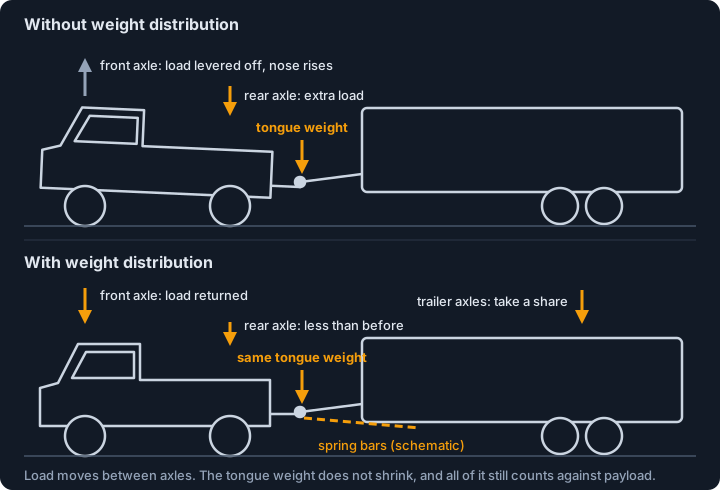
Tongue weight itself is the underlying variable, and Andersen states the band the same way the rest of the industry does: "Proper tongue weight should be 10-15% of total trailer weight. Below 10 percent causes sway. Above 15% overloads the rear axle and creates the problems weight distribution hitches solve."
If the truck is visibly squatting, you are past the point where a weight distribution hitch is optional equipment.
Test 4: Your Manufacturer's Own Threshold
This is the binding test, and the answer is not the same across the car park.
From Ford's 2023 guide, the vehicles listed as needing no weight distribution at all: Mustang, Bronco Sport, Transit Connect, Edge, Escape, Bronco, Explorer, Maverick and Ranger — all marked "Not Required."
And one listed as "Use Not Recommended": the Ford Transit. It is the only vehicle in Ford's table given that status, and it is a reminder that a weight distribution hitch is not universally appropriate hardware.
Ford also publishes a setup target rather than leaving adjustment to feel. Its Weight Distribution Correction Factor table asks you to restore 50% of the front-end height change on F-150, Super Duty, Expedition and Lightning — measured at the top of the front fender lip above the wheel centre, comparing the unhitched height with the hitched height. Andersen describes a comparable outcome for its own system: "With a 900 lb tongue weight system, you can expect roughly 30% of the weight to be transferred forward."
So: find your own manufacturer's number before buying anything. It will be in the towing guide for your model year or the owner's manual, and it beats every rule of thumb on this page.
When Not to Fit One
Three cases where a weight distribution hitch is the wrong answer.
Surge brake trailers. Andersen states it plainly: "As with all other Weight Distribution units, you cannot use the Andersen WD Hitch with surge brakes. The forward pressure of the weight distribution leverage will permanently engage the surge brakes." Note that Andersen is characterising the whole product category there, not only its own product — some chain-style systems are used with surge brakes under specific setups, so check your own hitch maker's guidance rather than treating this as settled for every product. Surge brakes are common on boat trailers.
Where the manufacturer says not to. The Ford Transit case above. If your vehicle's documentation says not recommended, that ends the discussion.
Over-tensioning it. More distribution is not better. Andersen warns: "removing too much tongue weight can reduce traction on the rear tires, especially on wet, slick, or gravel roads. The Andersen hitch is designed to leave a portion of the tongue weight on the rear axle to maintain traction and stability while towing." The goal is restoring the front axle, not unloading the rear.
There is also a floor for the sway-control function on some systems — Andersen notes theirs "requires at least 300 lbs of tongue weight to activate the sway control mechanism." A very light trailer may not give a WDH enough to work with.
And a limit worth stating plainly: a weight distribution hitch does not fix an under-rated tow vehicle. Andersen puts it as "a small crossover vehicle would likely be outside its towing limits, while a properly rated full-size truck or SUV would typically be a good match." If the payload is not there, redistributing it does not create any.
What It Does and Does Not Change
| Changes | Does not change |
|---|---|
| Which of the receiver's two ratings applies | The vehicle's maximum loaded trailer weight |
| How tongue load is split between the axles | The total tongue weight |
| Front axle load, and so steering and braking feel | GVWR, payload or any axle rating |
| How level the rig sits | The need to stay under rear GAWR |
That first row is the one people miss and the one that usually matters: the hitch unlocks a rating the hardware already had, on the condition that weight distribution is fitted.
Everything else on the right-hand column stays exactly where it was. Ford's own note requires that tongue load plus passengers plus cargo keep the vehicle within its rear GAWR and GVWR, with no exemption for having a weight distribution hitch fitted. The payload arithmetic is unchanged, and the hitch hardware itself is more payload spent: take its weight from the hitch maker's product listing, or weigh the head and bars. See does tongue weight count as payload.
For how the leverage actually works and how to set the bars, see the weight distribution hitch guide.
Frequently asked questions
At what trailer weight do I need a weight distribution hitch?
There is no single number — it depends on your receiver's weight-carrying rating. On a Ford F-150 that rating is 5,000 lb of trailer or 500 lb of tongue weight, above which weight distribution is required to use the receiver's higher 14,000 lb rating. A Ford Expedition's weight-carrying limit is 6,000 lb. Check your own towing guide, because the figure varies by vehicle and by model year.
Is the 50% rule real?
Partly. Andersen Hitches publishes it as: use a weight distribution hitch when the trailer weighs more than half the tow vehicle's GVWR. But Equal-i-zer's explainer contains no threshold at all, and neither Ford nor Ram uses a percentage — both publish absolute receiver ratings instead. Treat 50% as a prompt to check your receiver rating, which is the number that actually binds.
Does a weight distribution hitch increase towing capacity?
It increases which rating your receiver may be used at, not what your vehicle may tow. Ford is explicit that a receiver's weight-distributing capacity may exceed the vehicle's own maximum loaded trailer weight, and that the vehicle figure still governs. GVWR, payload and the axle ratings are all unchanged, and the hitch hardware itself consumes payload too; its weight is on the hitch maker's product listing.
Can I use a weight distribution hitch with surge brakes?
Andersen says no, and extends the warning to the category: the forward pressure from weight distribution leverage can permanently engage surge brakes. Since surge brakes are common on boat trailers this matters for boat owners in particular. Some chain-style systems are used with surge brakes under specific conditions, so check the guidance for your specific hitch rather than assuming either way.
How do I know the hitch is adjusted correctly?
Measure rather than judge by eye. Ford's method is to record the height at the top of the front fender lip above the wheel centre with the trailer unhitched, then hitched, and to tension the bars until roughly 50% of the drop has been restored on an F-150, Super Duty, Expedition or Lightning. A scale ticket showing front axle weight before and after is the definitive check.
Do I need a weight distribution hitch for a 5,000 lb trailer?
On an F-150 you are exactly at the weight-carrying limit of 5,000 lb, so anything above it requires weight distribution, and a trailer weighed at 5,000 lb before it is loaded will exceed it once water and gear go in. Tongue weight is the other trigger: at a planning figure of 13%, a 5,000 lb trailer puts about 650 lb on the ball, which is already past the 500 lb weight-carrying tongue limit. In practice, yes.

