Towing Basics
Dry Weight vs UVW vs GVWR vs CCC: Which Trailer Number to Use


On this page9 sections
Fast Answer: Shop on Dry Weight, Plan on GVWR
Match your truck to the trailer's GVWR, not its dry weight.
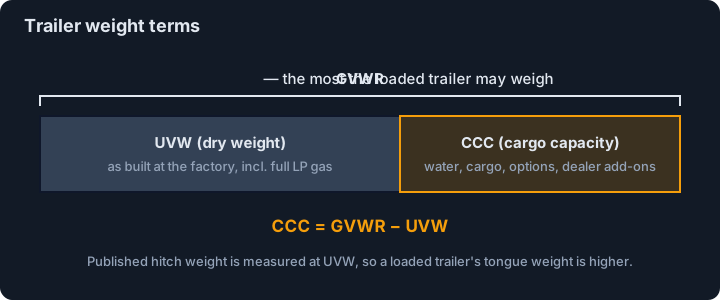
Dry weight (most manufacturers call it UVW, unloaded vehicle weight) is the trailer as it left the factory. Empty. No water, no gear, no dealer-installed anything. It is a useful shopping filter and a poor planning number, because you will never tow the trailer in that condition.
GVWR is the most the trailer is built to weigh once loaded. The gap between the two is CCC, the cargo carrying capacity, and it is the space you are about to fill.
The practical rule:
- Plan against GVWR, because that is where a fully packed trailer ends up.
- Convert GVWR to a tongue weight, then check that figure against your truck's payload — not its tow rating.
- Verify on a scale once loaded, because published weights are estimates and your trailer is not average.
That second step is the one most often skipped. A trailer can sit far below your tow rating and still ask for more payload than your truck has. Run your own numbers in the Truck and Trailer Weight Calculator, then confirm the whole rig with Can I Tow This?
The Four Numbers, and What Each One Answers
Forest River publishes plain-English definitions for its towables, and they are worth quoting because they are a manufacturer's own words rather than a summary:
UVW (unloaded vehicle weight) — "The typical weight of the unit as manufactured at the factory. It includes all weight at the unit's axle(s) and tongue or pin and LP Gas. The UVW does not include cargo, fresh potable water, additional optional equipment or dealer installed accessories."
GVWR — "The maximum permissible weight of the unit when fully loaded. It includes all weights, inclusive of all fluids, cargo, optional equipment and accessories."
CCC (cargo carrying capacity) — "The amount of weight available for fresh potable water, cargo, additional optional equipment and accessories. CCC is equal to GVWR minus UVW."
Hitch weight (or dry hitch weight) — the download the coupler puts on your ball. Published hitch figures are measured at UVW, so a loaded trailer's tongue weight is higher than the brochure figure.
Two details inside those definitions do real work:
- Propane is already counted in UVW. Full LP cylinders are inside the factory weight, so do not add them again as cargo. That is not just a manufacturer's convention. The federal labelling standard, FMVSS 110 (S4.3.5), says that on an RV trailer with a propane supply, "the weight of full propane tanks must be included in the vehicle's unloaded vehicle weight."
- Fresh water is not. The same section says on-board water "must be treated as cargo", and the trailer's cargo label has to state it: "A full load of water equals XXX kg or XXX lbs of cargo @ 1 kg/L (8.3 lb/gal)." Read that line on the trailer you are looking at; it tells you exactly how much of the cargo allowance the fresh tank takes.
That formula holds exactly. Across six 2027 Jayco Jay Feather floorplans, the published CCC equals GVWR minus UVW to the pound on every one — CCC is pure subtraction, not a separately engineered allowance.
A fifth number, GAWR, caps each axle. It is a separate limit from GVWR and the two do not add up the way most people assume — see GAWR vs GVWR.
The Catch: Every Brand Publishes a Different Subset
Here is something that makes cross-shopping harder than it should be. The three manufacturers checked for this guide each publish a different combination of the four numbers:
| Manufacturer | Dry weight | GVWR | CCC | Hitch weight |
|---|---|---|---|---|
| Jayco | UVW | Published | Published | Published |
| Grand Design | UVW | Published | Not published | Published |
| Forest River (Rockwood) | UVW | Not published | Published | Published |
Grand Design gives you a GVWR but leaves you to work out the cargo capacity. Forest River gives you the cargo capacity but not the GVWR. Only Jayco publishes both.
So when you compare two trailers from different brands, you are frequently comparing different quantities. If a spec page gives you any two of UVW, GVWR and CCC, you can derive the third — but derive it yourself and label it as derived, because it is not the manufacturer's published figure.
The number that settles it either way is the one printed on the trailer. Forest River says so directly: every unit is "weighed at the manufacturing facility prior to shipping" and carries a label with that unit's actual UVW and cargo capacity.
What Fills the Gap Between Dry and Loaded
Cargo capacity sounds generous until you price out what goes into it. Water leads by a wide margin. Propane figures below come from Manchester Tank, and battery weights from Lifeline and Battle Born.
| Item | Weight | Notes |
|---|---|---|
| Fresh water | 8.3 lb per gallon | Cargo, never included in UVW |
| 20 lb propane cylinder, full | about 38 lb each | Tare 18 lb + 20 lb propane — already inside UVW |
| 30 lb propane cylinder, full | about 55 lb each | Tare 25 lb + 30 lb propane — already inside UVW |
| Group 24 AGM battery (80 Ah) | 56 lb | Lifeline GPL-24T |
| Group 27 AGM battery (100 Ah) | 62 lb | Lifeline GPL-27T |
| 100 Ah lithium (LiFePO4) | 31 lb | Battle Born BB10012, fits a Group 27 tray |
Two things to take from that table.
Water is the big one. Across the eight floorplans in the next section that publish a cargo capacity, filling the fresh tank consumes between 27% and 33% of the entire allowance (tank capacity × 8.3 lb ÷ published CCC) before anyone loads a single bag. A 55-gallon tank is 456 lb.
Batteries are where weight is easiest to recover. At the same 100 Ah rating, the Group 27 AGM weighs 62 lb and the lithium equivalent weighs 31 lb — exactly half, and it drops into the same tray. Swapping two batteries returns 62 lb of cargo capacity.
And the mistake worth avoiding: do not add propane on top of UVW. It is already in there. Counting a pair of 20 lb cylinders again quietly removes 76 lb from a budget that was never actually spent.
For a full item-by-item build-up including gear, see the Truck and Trailer Weight Calculator.
Twelve Real Floorplans: Dry, Loaded and the Gap
These are current published figures, each set taken from that floorplan's own manufacturer page. Blank cells are numbers the manufacturer does not publish.
| Trailer (model year) | UVW | GVWR | CCC | Dry hitch | Fresh water |
|---|---|---|---|---|---|
| Jayco Jay Feather 18RBF (2027) | 4,655 lb | 6,200 lb | 1,545 lb | 490 lb | 55 gal |
| Jayco Jay Feather 21MML (2027) | 5,095 lb | 6,500 lb | 1,405 lb | 580 lb | 55 gal |
| Jayco Jay Feather 21MBH (2027) | 5,510 lb | 6,995 lb | 1,485 lb | 625 lb | 55 gal |
| Jayco Jay Feather 23RK (2027) | 5,765 lb | 7,400 lb | 1,635 lb | 665 lb | 55 gal |
| Jayco Jay Feather 24FK (2027) | 5,830 lb | 7,500 lb | 1,670 lb | 830 lb | 55 gal |
| Jayco Jay Feather 27BH (2027) | 6,725 lb | 8,200 lb | 1,475 lb | 860 lb | 55 gal |
| Grand Design Imagine XLS 17MKE (2026) | 4,945 lb | 6,395 lb | — | 525 lb | 37 gal |
| Grand Design Imagine XLS 22MLE (2026) | 5,358 lb | 6,995 lb | — | 664 lb | 37 gal |
| Grand Design Imagine XLS 23LDE (2026) | 5,711 lb | 6,995 lb | — | 650 lb | 37 gal |
| Grand Design Imagine XLS 25DBE (2026) | 6,313 lb | 7,995 lb | — | 656 lb | 37 gal |
| Rockwood Mini Lite 2109S (2027) | 4,472 lb | — | 1,365 lb | 557 lb | 53 gal |
| Rockwood Geo Pro G19FDT (2027) | 3,503 lb | — | 902 lb | 405 lb | 31 gal |
Worked example (hypothetical load) — Jay Feather 21MML. The trailer figures are Jayco's published ones; the cargo weights below are assumptions to show the method, not a measured trip. Dry it is 5,095 lb with a 580 lb hitch weight, which reads like an easy half-ton trailer. Now load it:
- Fill the 55-gallon fresh tank: 456 lb (55 × 8.3)
- Bedding, clothing and kitchen kit: 300 lb
- Chairs, grill, hoses, tools and a generator: 225 lb
- Food and drink: 100 lb
Cargo added: 1,081 lb of the 1,405 lb allowance, leaving 324 lb spare. Loaded weight is 6,176 lb — still under the 6,500 lb GVWR, so the trailer is fine.
The truck is the question. At 13% of loaded weight, a planning convention rather than a published figure, the tongue is carrying roughly 800 lb, against a published dry hitch weight of 580 lb. That extra 220 lb lands on your rear axle, and it comes straight out of payload. Work the tongue side through how to calculate tongue weight.
Why "Half-Ton Towable" Is a Dry-Weight Claim
The phrase does a lot of selling and very little promising.
Grand Design markets the Imagine XLS line as having "floorplans starting at under 5,000-pounds." That is true — of the UVW. The lightest floorplan, the 17MKE, has a UVW of 4,945 lb. Its GVWR is 6,395 lb. The claim is accurate and the number you tow is nearly 1,500 lb higher.
Individual floorplan pages carry a feature block titled "Towing Conveniences - Under 30' + Half-Ton Towable". On the 25DBE, the same page publishes a GVWR of 7,995 lb.
Nothing there is false. The trailer's dry weight really is modest, and plenty of half-tons really can pull 7,995 lb. But "towable" is a statement about tow rating, and tow rating is rarely the limit that stops a half-ton. Payload is.
Run the check yourself in five minutes:
- Take the trailer's GVWR (not dry weight).
- Multiply by 13% for a conventional trailer to estimate loaded tongue weight.
- Add your passengers, your gear, your hitch hardware.
- Compare that total against the payload figure on your truck's door sticker.
For the 25DBE at 7,995 lb GVWR, step 2 alone lands near 1,040 lb of tongue weight. Add four occupants (assume 600 lb; use your real weights) and a weight distribution hitch (assume 90 lb; the hitch maker lists the real figure) and the payload demand is about 1,730 lb. Plenty of crew-cab half-tons are labelled for less than that; compare it with your own door placard, and see the payload capacity chart for published maximums by model. The mechanics of that are in payload vs towing capacity, and half-ton fifth-wheel towing covers the same trap with pin weight.
The Brochure Is an Estimate. The Sticker Is the Number.
Published trailer weights are not measurements of the trailer you are looking at, and manufacturers say so.
Forest River footnotes both its UVW and CCC figures as an "Estimated Average based on standard build optional equipment" — while stating in the same document that every unit is individually weighed before it ships and labelled with its actual UVW and cargo capacity.
The disclaimers are consistent across brands:
- Grand Design: "All information, content and specifications on this website can be subject to change without notice. Please consult with your dealer for current product information and specifications."
- Forest River: "...it may be necessary to make revisions and Forest River, Inc. reserves the right to make changes without notice, including prices, colors, materials, equipment and specifications..."
- Jayco: "Virtual Floorplan Showings and Product Specifics Are Subject to Change Without Notice"
None of that is evasive; it is how build variation works. Options, a different awning, a second battery, an upgraded axle package — each moves the number, and the website figure was computed on a standard build.
Which leads to the only weight that is actually about your trailer:
- The yellow cargo capacity label on the trailer. For RV trailers this reads "The weight of cargo should never exceed..." and reflects that unit as built.
- A scale ticket, loaded the way you actually travel. The CAT Scale guide covers the passes that also give you a true tongue weight.
Treat the brochure as a shortlist tool and the sticker as the specification.
What to Ask Before You Sign
Bring these to the dealer lot. Each one closes a gap the brochure leaves open.
- "What is the GVWR?" If the salesperson answers with the dry weight, ask again. On a Forest River unit the GVWR may not be on the website at all.
- "Can I see the weight label on this actual unit?" The certification label is on the forward half of the left side, and FMVSS 110 requires the cargo label to sit next to it. The UVW, cargo capacity and "full load of water" figures on those labels beat any printed figure.
- "What options are on this one, and are they in that number?" Dealer-installed accessories are explicitly outside UVW.
- "What is the cargo capacity after the options?" Every added pound comes out of CCC, not out of GVWR.
- "What does the tongue weigh loaded, not dry?" The published hitch figure is measured empty.
- "Does it have one battery or two, and what type?" Two AGM batteries instead of lithium is about 62 lb of cargo capacity.
Then do the arithmetic that actually decides it — the trailer's GVWR against your truck's payload, not against its tow rating. Our truck payload guide explains where to find your real figure, and the trailer weight chart gives typical weights by trailer type if you are still narrowing the field.
Frequently asked questions
Should I use dry weight or GVWR to check what my truck can tow?
Use GVWR. Dry weight, or UVW, is the trailer as it left the factory with no water, cargo or dealer-installed accessories, and you will never tow it in that state. GVWR is the maximum the trailer is built to weigh loaded, so it is the figure that reflects how the trailer will actually travel. Convert GVWR into a tongue weight and check that against your truck's payload rather than its tow rating.
What is UVW on a travel trailer?
UVW stands for unloaded vehicle weight — the manufacturer's figure for the trailer as built at the factory. Forest River defines it as including all weight at the axles and tongue plus LP gas, while excluding cargo, fresh potable water, optional equipment and dealer-installed accessories. Note that propane is inside UVW but fresh water is not, so do not count full propane cylinders again as cargo.
What does CCC mean on a travel trailer?
CCC is cargo carrying capacity, and it is simply GVWR minus UVW — the weight left over for water, gear, and anything added after the factory. Across six 2027 Jayco Jay Feather floorplans the published CCC matches that subtraction exactly. Not every manufacturer publishes it: Grand Design publishes GVWR without CCC, while Forest River publishes CCC without GVWR.
How much does a full fresh water tank weigh?
Budget 8.3 lb per gallon, the figure the RV industry and the federal RV trailer labelling rule both use. A 55-gallon tank is about 456 lb and a 37-gallon tank about 307 lb. Across the eight floorplans in this guide that publish a cargo capacity, filling the fresh tank consumes between 27% and 33% of the trailer's entire allowance before any gear goes aboard, which is why many owners tow with empty tanks and fill at the campsite.
Is the hitch weight on the spec sheet the weight I will actually tow?
No. Published hitch or tongue weight is measured at the trailer's dry weight, so it rises once the trailer is loaded. As a planning convention a conventional trailer carries about 10-15% of its loaded weight on the tongue, so a trailer listed at a 580 lb dry hitch can present around 800 lb once loaded near its GVWR. That increase lands on your tow vehicle's rear axle and comes out of payload.
Does "half-ton towable" mean my half-ton truck can tow it?
Not on its own. It is a marketing description tied to tow rating, and tow rating is rarely what stops a half-ton — payload usually is. Grand Design markets Imagine XLS floorplans with GVWRs of 6,995 lb and 7,995 lb as half-ton towable. A 7,995 lb trailer at a 13% planning tongue percentage asks for roughly 1,040 lb of tongue weight before passengers, gear and hitch hardware. Add those and the total can exceed the payload printed on a well-equipped crew cab's door placard, which is the number to check.
Continue reading
- Payload/12 min read"Half-Ton Towable" Is a Payload Claim: Check It in 5 Minutes
- Towing Basics/16 min readWhat Can I Tow With My Towing Capacity? The 3,500 to 15,000 lb Ladder
- Towing Basics/15 min readGAWR vs GVWR: Axle Ratings, Front/Rear, and Why the Sum Is Not the GVWR
- Towing Physics/22 min readPayload vs. Towing Capacity: Why Payload Can Run Out First
- Towing Mathematics/14 min readHow to Calculate Tongue Weight: Bumper-Pulls & 5th Wheel Pins