Towing Basics
GAWR vs GVWR: Axle Ratings, Front/Rear, and Why the Sum Is Not the GVWR


On this page10 sections
Fast Answer: Two Ratings, Two Different Jobs
GVWR is the ceiling for the entire loaded vehicle. GAWR is the ceiling for one axle system at a time, and your vehicle has a separate one for the front and the rear.
They are two independent numbers chosen by the manufacturer. That leads to the point most towing guides skip:
Front GAWR + Rear GAWR does not equal GVWR — and it is not supposed to.
On light trucks the two axle ratings commonly add up to more than the GVWR. That extra is engineering headroom for uneven loading, not permission to carry more. You have to stay under all three limits at once: the front axle, the rear axle, and the vehicle total.
This matters for towing because tongue weight does not land evenly. It lands behind the rear axle, which means the rear GAWR is usually the first rating a loaded tow vehicle runs out of — often while the total weight still looks comfortably under GVWR.
Check your own setup with the GVWR Calculator, size the load with the Payload Calculator, or run the whole rig through Can I Tow This?
What Each Rating Actually Means
Both terms are defined in federal regulation, and the exact wording is worth reading because it explains the difference.
GVWR. Under 49 CFR 571.3, gross vehicle weight rating "means the value specified by the manufacturer as the loaded weight of a single vehicle." One number, whole vehicle, fully loaded.
GAWR. In the same section, gross axle weight rating "means the value specified by the vehicle manufacturer as the load-carrying capacity of a single axle system, as measured at the tire-ground interfaces."
Ford states the same rule in its own towing guide: "Gross Axle Weight Rating (GAWR) is the maximum weight to be carried by a single axle (front or rear)... The total load on each axle must never exceed its GAWR."
That last phrase in the federal definition does a lot of work. GAWR is not a rating of the axle shaft alone. It is a rating of everything in the load path where it meets the road — axle, springs, wheel bearings, wheels, and tires. Change the tires to something with a lower load rating and the axle system can no longer honestly carry its printed GAWR. That is why the tire size and cold inflation pressure are printed right next to the GAWR on the label.
Two related definitions from the same regulation help place them:
- GCWR is "the value specified by the manufacturer as the loaded weight of a combination vehicle" — truck plus trailer together.
- Curb weight is the vehicle with standard equipment and a full load of fuel, oil and coolant, but no people and no cargo.
So the hierarchy runs: GAWR governs one axle, GVWR governs the loaded truck, and GCWR governs the truck and trailer as a pair. Our GVWR vs GCWR guide covers that last pairing in depth.
Why the Two Axle Ratings Do Not Add Up to the GVWR
Here is the cleanest proof available, and it comes from the regulation itself rather than from opinion.
Federal safety standard FMVSS 110 shows manufacturers the required label format using a worked truck example:
| Label line (FMVSS 110 S4.3.3 example) | Value |
|---|---|
| GVWR | 5,381 lb |
| GAWR — Front | 2,864 lb |
| GAWR — Rear | 2,864 lb |
Add the two axle ratings: 5,728 lb. The GVWR on the very same example label is 5,381 lb. The axles are rated for 347 lb more than the vehicle is allowed to weigh.
That is not a mistake in the regulation. It is normal. Axles are engineered with margin because load never distributes perfectly, and a manufacturer sizes each axle for the worst case it might see rather than for an even split.
The rule you can actually use: the lowest applicable limit wins. Being under the sum of the axle ratings means nothing on its own. You must be under the front GAWR, under the rear GAWR, and under the GVWR.
Does it ever run the other way? Not usefully. The heavier-vehicle standard FMVSS 120 prints two more example labels, and in both the axle ratings sum to exactly the GVWR — provided you do the arithmetic in kilograms, the units the regulation is actually written in. In pounds one of them appears to land 9 lb short, but that is an artifact of rounding each converted value separately, not a real gap.
The truck-equipment industry states the direction plainly. The National Truck Equipment Association puts it this way: GVWR "cannot exceed the sum of all GAWRs."
So the working relationship is GVWR ≤ front GAWR + rear GAWR — equal at best, usually with a few hundred pounds of axle margin on top. What it never means is that you may load to the sum.
One more thing worth knowing: for ordinary pickups and SUVs there is no federal rule at all connecting the sum of the axle ratings to the GVWR. The only places the standards impose a relationship are motor homes and RV trailers, which we come back to below.
What This Looks Like on Real Vehicles
Manufacturer towing brochures are not where you will find this. Ford's 2023 RV & Trailer Towing Guide and every Toyota Tacoma and Tundra product-information sheet publish GVWR and payload but no GAWR at all — Ford's guide includes a sample certification-label diagram with the GAWR boxes deliberately left blank and the caption "Refer to actual label on your vehicle."
Where the numbers do get published is fleet and upfitter documentation. These figures come from official GM fleet specification guides hosted by GM Upfitter Integration:
| Vehicle (GM fleet spec guide) | GVWR | Front GAWR | Rear GAWR | Front + Rear |
|---|---|---|---|---|
| 2026 Chevrolet Tahoe 9C1, 2WD | 7,400 lb | 3,700 lb | 4,300 lb | 8,000 lb (+600) |
| 2026 Chevrolet Tahoe 9C1, 4WD | 7,600 lb | 3,700 lb | 4,300 lb | 8,000 lb (+400) |
| 2026 Chevrolet Tahoe 5W4 SSV, 4WD | 7,600 lb | 3,700 lb | 4,300 lb | 8,000 lb (+400) |
| 2022 Chevrolet Suburban 1FL, 2WD | 7,500 lb | 3,600 lb | 4,300 lb | 7,900 lb (+400) |
| 2022 Chevrolet Suburban 1FL, 4WD | 7,700 lb | 3,800 lb | 4,300 lb | 8,100 lb (+400) |
Every row shows the same pattern: the axles are rated for 400 to 600 lb more than the vehicle is allowed to weigh. Note also that the rear GAWR exceeds the front on all of them, which is normal for a body-on-frame vehicle expected to carry load behind the cab — and that the 4WD versions gain GVWR without gaining any axle rating, because the extra weight is drivetrain.
GM states the loading rule in its own guides in capitals: "DO NOT LOAD THE VEHICLE ANY HEAVIER THAN THE GROSS VEHICLE WEIGHT RATING (GVWR), OR EITHER THE MAXIMUM FRONT OR REAR GROSS AXLE WEIGHT RATING (GAWR)." Three separate ceilings, all binding at once.
A sanity check worth knowing — because it catches published mistakes. Since GVWR should never exceed the sum of the axle ratings, any spec sheet where the axles add up to less than the GVWR deserves a second look. The Chevrolet Silverado 1500 9C1 fleet guides for both 2025 and 2026 list a 7,100 lb GVWR with a 3,800 lb front GAWR and a 2,060 lb rear GAWR. Those axles total 5,860 lb — 1,240 lb below the vehicle's own GVWR, and below what the truck's rear axle already carries empty at a 5,201 lb curb weight. The rear figure is almost certainly a publication error rather than a real rating, repeated across two model years.
The lesson is not that manufacturers are careless. It is that the label on your vehicle is the authority, and a quick "do these add up sensibly?" check costs nothing.
The Failure That Catches Towers: Under GVWR, Over Rear GAWR
This is the scenario the whole article exists for, because it is the overload a total-weight check cannot see.
Tongue weight is applied at the hitch ball, which sits behind the rear axle. The rear axle therefore acts as a fulcrum: the load presses down behind it, so the rear axle picks up more than the tongue weight itself while the front axle is levered slightly upward. The split follows from taking moments about the front axle:
Here overhang is the distance from the rear axle centerline to the hitch ball. Measure it with a tape; take the wheelbase from the spec sheet. For a hypothetical truck with a 145 in wheelbase and a 50 in overhang, 100 lb of tongue weight adds about 134 lb to the rear axle and takes about 34 lb off the front. A longer overhang or a shorter wheelbase makes the transfer larger.
Now watch what that does to a plausible half-ton setup. These figures are illustrative — use your own label and your own scale ticket.
| Rating from the door label | Value |
|---|---|
| GVWR | 7,050 lb |
| GAWR — Front | 3,750 lb |
| GAWR — Rear | 3,900 lb |
| Sum of the axle ratings | 7,650 lb |
Loaded for a trip with a family aboard and a trailer hitched, the scale ticket reads:
| Scale reading | Weight | Limit | Margin |
|---|---|---|---|
| Front axle | 2,980 lb | 3,750 lb | 770 lb under |
| Rear axle | 3,960 lb | 3,900 lb | 60 lb OVER |
| Truck total | 6,940 lb | 7,050 lb | 110 lb under |
The truck is under its GVWR and would pass any check based on total weight alone. The front axle has 770 lb of margin. And the rear axle is still over its own rating, because tongue weight and bed cargo both land at the back.
Federal regulation actually requires your owner's manual to warn you about this transfer. Under 49 CFR 575.6, manuals must carry this verbatim line:
"If your vehicle will be towing a trailer, load from your trailer will be transferred to your vehicle. Consult this manual to determine how this reduces the available cargo and luggage load capacity of your vehicle."
NHTSA makes the same point even more bluntly on motor home capacity labels, which are required to read that "the tongue weight of a towed trailer counts as cargo." That specific label wording applies to motor homes rather than pickups, but the principle is identical for any tongue-pull setup.
What to do when the rear axle is the limit:
- Move dense cargo out of the bed and forward into the cab, or into the trailer ahead of its axles.
- Check the tongue weight itself — see how to calculate tongue weight. Above roughly 15% of loaded trailer weight, the trailer is nose-heavy.
- Fit a properly adjusted weight distribution hitch, which transfers part of the tongue load back onto the front axle and the trailer's axles. Our weight distribution hitch guide covers what it does and does not change.
- Understand that airbags and helper springs level the truck but do not raise any printed rating.
How to Check Your Own Axle Weights
Ratings are only half the picture. The other half is what your rig actually weighs, and that requires a scale rather than an estimate.
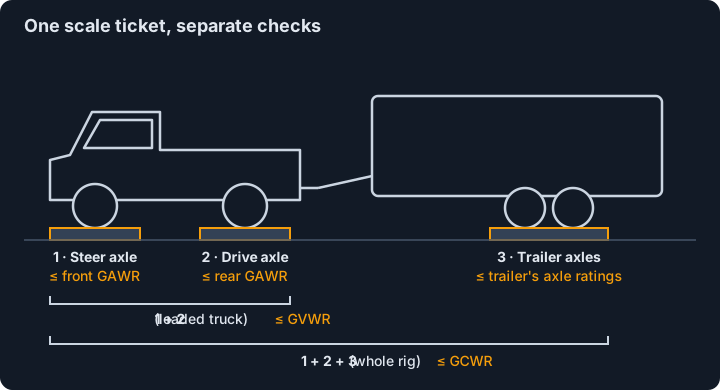
A truck-stop scale reports your weight in separate axle groups, which lines up precisely with how the ratings are written:
- Steer axle — compare against the front GAWR.
- Drive axle — compare against the rear GAWR.
- Trailer axles — compare against the trailer's own GAWR figures.
Weigh the rig loaded the way you actually travel: full fuel, water, passengers, gear, and the trailer connected. Then run three comparisons rather than one:
- Front axle weight vs front GAWR
- Rear axle weight vs rear GAWR
- Truck total (front + rear) vs GVWR
Only when all three pass is the tow vehicle within its ratings.
Even that is not the finest granularity available. The RV Safety & Education Foundation, which runs wheel-position weighing at RV rallies, points out that "it is possible to be within your Gross Vehicle Weight Rating (GVWR) and your Gross Axle Weight Ratings (GAWR), and still overload a tire at an individual wheel position." An axle can pass while one side of it is overloaded, because a scale pad reports the axle as a whole. Side-to-side balance matters as much as front-to-rear. The CAT Scale weighing guide walks through the three-pass method that also yields your true tongue weight, and the Truck and Trailer Weight Calculator helps you predict the numbers before you drive to a scale.
Trailer GVWR vs Trailer Axle GAWR
Trailers have both ratings too, and here the gap between them is not just normal — for RV trailers it is written into federal law.
FMVSS 110 S9.2 states the requirement directly:
"On RV trailers, the sum of the GAWRs of all axles on the vehicle plus the vehicle manufacturer's recommended tongue weight must not be less than the GVWR. If tongue weight is specified as a range, the minimum value must be used."
Rearranged, that is the whole idea in one line:
The trailer's axles are not required to carry the trailer's full rated weight, because the coupler hands part of that load to the tow vehicle. A tandem-axle trailer with two 5,200 lb axles has 10,400 lb of axle capacity and may legitimately carry a GVWR meaningfully above that figure — the difference rides on your hitch ball, and lands on your rear axle.
That single fact connects the two halves of this guide: the weight missing from the trailer's axle ratings is exactly the weight that shows up on your truck's rear GAWR.
Common trailer axle capacities are standardized. Dexter, one of the largest trailer axle manufacturers, lists light-duty axles from 1,000 to 8,000 lb, including the familiar 3,500, 5,200, 6,000 and 7,000 lb ratings, with medium-duty axles spanning 9,000 to 15,000 lb.
Two scope notes, stated honestly: the S9.2 requirement is written for recreation vehicle trailers specifically, though the physics applies to any tongue-pull trailer. And for motor homes the standard runs the other way — FMVSS 110 S9.1 requires the sum of the axle ratings to be at least the GVWR, since a motor home has no tongue to offload onto.
You can size the trailer side of the equation with the trailer weight chart.
Your Tires Have to Support the GAWR Too
Because GAWR is measured at the tire-ground interface, the tires are part of the rating rather than an accessory to it.
FMVSS 110 S4.2.2.1 sets the rule for vehicles rated at 10,000 lb GVWR or less — which covers essentially every half-ton pickup and SUV:
"The sum of the maximum load ratings of the tires fitted to an axle shall not be less than the GAWR of the axle system as specified on the vehicle's certification label."
Two tires on the front axle, each rated 1,900 lb, give 3,800 lb of tire capacity against a 3,750 lb front GAWR. That passes. Fit a tire with a lower load rating and the arithmetic can quietly fail even though nothing about the axle changed.
Three details that catch people out:
- Load rating is tied to a pressure. A tire's maximum load rating is stated at a specific cold inflation pressure. Run it softer and it is no longer carrying its rated load. This is why the label prints tire size, rim size and cold pressure next to each GAWR.
- Passenger-car tires get derated on a truck. Under FMVSS 110 S4.2.2.2, when a P-metric passenger-car tire is fitted to a truck, MPV, bus or trailer, "each tire's load rating is reduced by dividing it by 1.10" before it counts toward the GAWR — roughly a 9% haircut. A P-metric tire that looks adequate on paper may not be.
- More than one GAWR can be listed. If the label shows several GAWR values for an axle, the one that applies is the one matching the tire size actually fitted.
Tire condition and age matter separately from rating, and the trailer sway guide covers how underinflated or overloaded tires feed instability.
Where to Read These Numbers on Your Vehicle
Both ratings live on the certification label, and federal rules dictate almost everything about it.
Under 49 CFR 567.4:
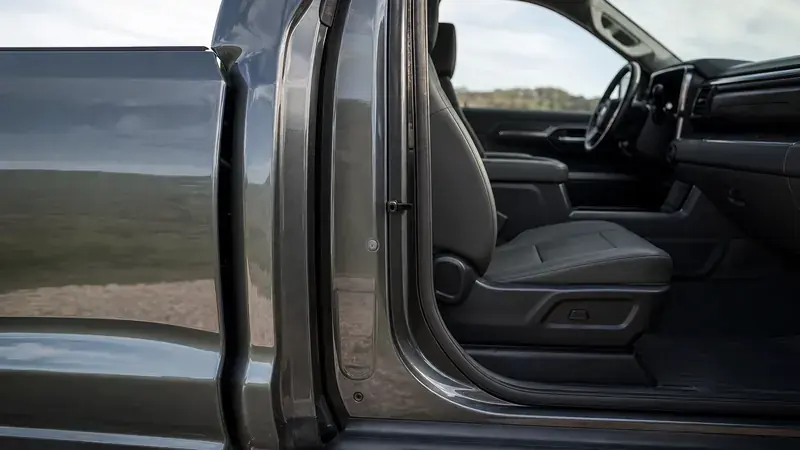
- Location. On everything except trailers and motorcycles, the label goes on the hinge pillar, door-latch post, or the door edge that meets the door-latch post, next to the driver's seating position. On a trailer, it goes on the forward half of the left side.
- Permanence. It must be "riveted or permanently affixed in such a manner that it cannot be removed without destroying or defacing it." A printed sticker you can peel off is not it.
- Order. The required lines appear in a fixed sequence: manufacturer, month and year of manufacture, GVWR, then GAWR for each axle "identified in order from front to rear," then the conformity statement, VIN, and vehicle type.
- GVWR is a floor, not a formula. The regulation says GVWR "shall not be less than the sum of the unloaded vehicle weight, rated cargo load, and 150 pounds times the number of the vehicle's designated seating positions." It sets a minimum. Nothing caps it against the axle ratings — which is precisely why the two do not track each other.
Do not confuse it with the yellow placard. A separate Tire and Loading Information placard, required by FMVSS 110 S4.3 on the driver's side B-pillar, carries the payload line: "The combined weight of occupants and cargo should never exceed XXX kilograms or XXX pounds." On a trailer the equivalent reads "The weight of cargo should never exceed..." instead.
So: payload comes off the yellow placard; GVWR and GAWR come off the certification label. Our guide to reading the towing sticker decodes every line on both, and the payload guide explains what eats the number once you have it.
One caution worth repeating: GAWR is build-specific. Two trucks of the same model and year can carry different axle ratings depending on their configuration, and manufacturer towing brochures generally publish GVWR and payload without publishing the front/rear GAWR split. Read the label on the actual vehicle rather than a spec sheet.
Frequently asked questions
What does GAWR FRT mean on my door sticker?
GAWR FRT is the Gross Axle Weight Rating for the front axle. GAWR RR is the same figure for the rear axle. Federal rules require the label to list a GAWR for each axle in order from front to rear, so a two-axle vehicle shows two values. Each one is the maximum that axle system is rated to carry, measured at the tire-ground interfaces, with the tire and rim combination printed alongside it.
Is the GVWR the same as the front and rear GAWR added together?
No, and the two rarely match. They are separate values chosen by the manufacturer. On light trucks the axle ratings commonly add up to more than the GVWR — NHTSA's own example label in FMVSS 110 pairs two 2,864 lb axle ratings, totalling 5,728 lb, with a 5,381 lb GVWR. The extra is engineering margin for uneven loading, not extra capacity. You must stay under the front GAWR, the rear GAWR, and the GVWR at the same time.
Can I be over the rear GAWR while still under the GVWR?
Yes, and while towing it is common. Tongue weight is applied behind the rear axle, so the rear axle gains more than the tongue weight itself (tongue × (wheelbase + hitch overhang) ÷ wheelbase) while the front axle is levered slightly lighter. The total can still sit below GVWR because weight was effectively moved from the front axle to the rear rather than added to the vehicle. Only a scale ticket showing each axle separately will reveal it.
Why is a trailer's GVWR higher than its axle ratings add up to?
Because the tongue carries the difference. For RV trailers, FMVSS 110 S9.2 requires that the sum of the axle GAWRs plus the manufacturer's recommended tongue weight is at least the GVWR. The axles are not expected to carry the whole rated load — the coupler hands part of it to the tow vehicle, where it lands on the rear axle. That transferred load is why a trailer's numbers and your truck's rear GAWR have to be checked together.
Where do I find my GAWR if the towing brochure doesn't list it?
On the certification label in the driver's door area — the permanently affixed one, not the yellow payload placard. Manufacturer towing guides usually publish GVWR, curb weight, payload and tow ratings, but often omit the front and rear GAWR split because it varies by build. Since the ratings are configuration-specific, read them from the label on the actual vehicle rather than from a spec sheet for the model.
Does a weight distribution hitch change my axle weights?
It changes how the tongue load is distributed, not how much load exists. Spring bars apply leverage at the hitch head that transfers part of the tongue weight off the tow vehicle's rear axle and onto its front axle and the trailer's axles, which can bring a rear axle back under its GAWR and restore front-axle steering load. It does not raise the GVWR, any GAWR, or the payload rating. Verify the result on a scale rather than assuming it.
Continue reading
- Towing Basics/14 min readDry Weight vs UVW vs GVWR vs CCC: Which Trailer Number to Use
- Towing Physics/22 min readPayload vs. Towing Capacity: Why Payload Can Run Out First
- Towing Mathematics/14 min readHow to Calculate Tongue Weight: Bumper-Pulls & 5th Wheel Pins

- Towing Basics/14 min readHow to Read a Towing Sticker: Payload Placard and Certification Label