Towing Mathematics
How to Calculate Tongue Weight: Bumper-Pulls & 5th Wheel Pins


On this page11 sections
Fast Answer: The Number and the Three Ways to Get It
A conventional trailer is usually planned at 10-15% of its loaded weight on the tongue. A fifth wheel or gooseneck is planned at 15-25% on the pin. These are guidelines, not ratings. Manufacturers state their own figures: Ford's 2024 F-150 towing guide says "Trailer tongue load weight should be 10% of total loaded trailer weight" and "Trailer king pin load weight should be 15% of total loaded trailer weight," and computes its ratings on those numbers. Your owner's manual and the trailer manufacturer's instructions take precedence over any general range.
A few common weights, using 13% as a mid-band planning figure:
| Loaded trailer | 10% | 13% | 15% |
|---|---|---|---|
| 4,000 lb | 400 lb | 520 lb | 600 lb |
| 6,000 lb | 600 lb | 780 lb | 900 lb |
| 8,000 lb | 800 lb | 1,040 lb | 1,200 lb |
| 10,000 lb | 1,000 lb | 1,300 lb | 1,500 lb |
The full table from 2,000 to 12,000 lb is on the travel trailer tongue weight chart, and the tongue weight calculator will work your exact figure and tell you the payload it consumes.
There are three ways to find your real number, covered below: a bathroom scale and a beam, a commercial truck scale using the three-pass method, or a dedicated tongue scale or scale hitch. A percentage estimate is fine for shopping; measure before a long trip.
One thing to settle first: every pound of tongue weight comes out of your truck's payload. See does tongue weight count as payload.
Symptoms of Too Little and Too Much
Before measuring, it is worth knowing what each failure feels like from the driver's seat.
| Symptom | Likely cause | What to check |
|---|---|---|
| Trailer begins to weave at highway speed | Too little tongue weight | Move cargo forward of the trailer axles |
| Sway that worsens when a truck passes | Too little tongue weight | Load balance, then sway control |
| Truck rear sags, headlights point up | Too much tongue weight | Tongue weight against payload and rear GAWR |
| Steering feels light or vague | Too much tongue weight levering the front axle up | Front axle weight on a scale; a weight distribution hitch |
| Trailer nose sits low, tows heavily | Too much tongue weight | Move cargo rearward, but stay above 10% |
| Rear tyres wearing on the inner edges | Rear axle near or over its rating | Rear axle weight against GAWR |
Too little is the more dangerous of the two, because it produces sway, and sway gets worse rather than better as speed rises. Too much is usually the more expensive, because it shows up as an overloaded rear axle. The physics of the first is in what is trailer sway, and the axle side is in GAWR vs GVWR.
The Tongue Weight Target Range
How to Calculate Tongue Weight: Tongue weight is the static downward force the trailer coupler puts on the hitch ball. The usual planning window is 10% to 15% of loaded trailer weight for a conventional trailer and 15% to 25% (pin weight) for a fifth wheel or gooseneck, unless your vehicle or trailer manufacturer states a different figure.
What happens outside the window:
Too little (under about 10%):
The trailer's center of gravity sits closer to its axles, so less of its weight works to keep it lined up behind the hitch. The trailer is then more easily set swinging by a crosswind, a road dip or a passing truck, and the oscillation is harder to damp at higher speed. See trailer sway.
Too much (over about 15%):
The extra load lands behind the tow vehicle's rear axle. It can push the rear axle past its GAWR or the truck past its payload, lifts load off the front axle (lighter steering and less front braking grip), and tilts the headlights up. Check the totals with the Towing Payload Calculator.
Method 1: The Bathroom Scale & Wood Beam Method (DIY)
Without a tongue scale, a bathroom scale and a stiff beam make a lever that measures loads several times the scale's own capacity. You need a sturdy, straight beam (a 4x4 is safer than a 2x4, which can flex or crack under a heavy tongue), two short lengths of steel pipe, a solid block the same height as the scale, and a tape measure.
How the lever works. The beam rests on a pipe on the block at one end and a pipe on the scale at the other. The tongue jack presses on the beam at distance A from the block support and distance B from the scale support. Taking moments about the block, the scale carries the share A ÷ (A + B) of the tongue load, plus half the beam's own weight. Rearranged:
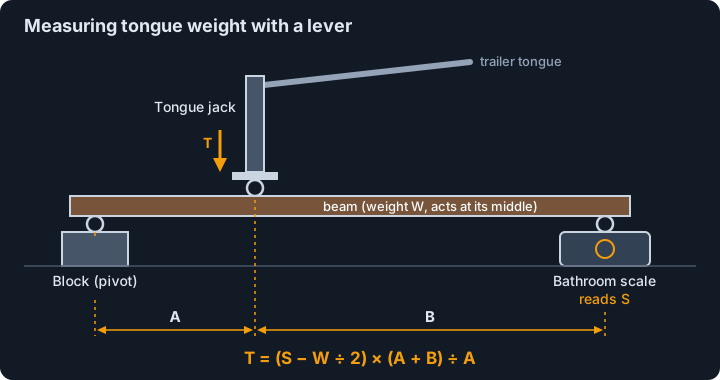
where T is tongue weight, S the scale reading and W the weight of the beam. Only half the beam's weight comes off, because the block carries the other half.
Steps:
- Weigh the beam on the bathroom scale and note W.
- Set the block and the scale on firm, level ground, with the beam resting on a pipe on each, so the two supports are A + B apart.
- Mark the jack position on the beam. With A = 12 in and B = 36 in the multiplier is (12 + 36) ÷ 12 = 4; with A = 12 in and B = 24 in it is 3.
- Chock the trailer wheels, then lower the tongue jack onto the beam at the mark (a short pipe or block under the jack foot keeps the load on the mark).
- Read the scale (S) and apply the formula.
A shortcut for step 1: with the beam resting on both supports and nothing on it, the scale reads W/2 on its own. Subtract that empty-beam reading from S. Do not subtract the beam's full weighed weight, which would be W.
Worked example (hypothetical numbers). A = 12 in, B = 36 in, beam W = 12 lb, scale reads S = 160 lb. Then T = (160 − 6) × 4 = 616 lb. Subtracting the full 12 lb instead would give 592 lb, understating the tongue by 24 lb.
A 300-lb bathroom scale with a 4:1 lever reads tongues up to roughly 1,200 lb. Keep the scale reading well inside its capacity, and if the result is near any limit that matters, confirm it on a commercial scale. The calculator below and the Trailer Tongue Weight Calculator use the same formula.
DIY Wood Beam Bathroom Scale Calculator
Enter the scale reading, the two distances and the beam's weight. The calculator applies T = (S − W/2) × (A + B) ÷ A from the method above.
Try it
Wood Beam Bathroom Scale Calculator
Convert DIY mechanical lever bathroom scale readings into true trailer coupler tongue weight.
Calculated Coupler Tongue Weight
456lbs
- Mechanical Ratio
- 4.00x
- Beam weight (subtracted)
- −24 lbs
Lever layout
Your beam creates a 4.0:1 mechanical disadvantage lever. The trailer jack pushes down close to the solid support block (Distance A). The bathroom scale (Distance A + B) reads about 1/4.0 of the weight plus half of the wood beam's static mass. Lowering your jack onto the pipe gives you a practical estimate without overloading the bathroom scale.
Method 2: The CAT Scale 3-Pass Method
For the strongest evidence, take the loaded rig to a certified commercial truck scale, such as a CAT Scale at a truck stop. The scale reports each axle group separately. Fees vary by location and a reweigh is charged separately, so ask at the fuel desk.
Three passes give tongue weight, axle loads, and how well a weight distribution hitch is working:
Pass 1: truck and trailer hitched, weight distribution bars connected and tensioned.
Truck front axle on platform 1, truck rear axle on platform 2, trailer axles on platform 3. This is how you will drive.
Pass 2: truck and trailer hitched, weight distribution bars disconnected.
Same positions. This shows what the tongue does to the truck without the bars.
Pass 3: truck only.
Unhitch and park the trailer off the scale, then weigh the truck alone, with the same people and cargo aboard.
Tongue weight:
Other checks from the same tickets:
- Compare each truck axle in Pass 1 with its GAWR, and the Pass 1 truck total with GVWR.
- Compare the Pass 1 grand total with GCWR.
- Compare the Pass 1 front axle with Pass 3. Hitch makers give a target for how much front-axle load the bars should restore; the difference between the passes tells you whether you are there.
The CAT Scale guide walks through the visit itself.
Key terms: weighing and weight distribution
Terms used when weighing and balancing a rig:
- Static tongue weight: The downward force of the coupler on the hitch ball with the rig stationary and level. This is the number the 10-15% guideline and the hitch ratings refer to.
- Dynamic tongue load: The momentary force at the ball while moving. Bumps and pitching make it swing above and below the static figure, which is one reason hitch and axle ratings carry margin. You cannot measure it with a static scale, and the ratings are written against the static value.
- Pin weight: The downward force of a fifth-wheel or gooseneck kingpin on the hitch in the bed. Because the hitch sits over or just ahead of the rear axle, there is little lever effect on the front axle.
- Spring bar tension: The preload a weight distribution hitch's bars apply at the hitch head, which moves part of the tongue load from the tow vehicle's rear axle to its front axle and the trailer axles.
- Tare (Pass 3) weight: The tow vehicle weighed alone, loaded as it will travel but unhitched. Subtracting it from the hitched truck weight isolates tongue weight.
Method 3: Direct Hydraulic & Scale Hitches
If you tow often or change loads regularly, a dedicated tongue scale or a scale-integrated hitch saves the setup. Check its capacity against your expected tongue weight before buying:
Hydraulic Tongue Scales (e.g., Sherline LM-1000):
A compact scale that sits under the trailer jack and reads directly in pounds when you lower the jack onto it.
Integrated Scale Hitches (e.g., Weigh-Safe):
A ball mount with a built-in gauge. Drop the coupler onto the ball and the gauge shows tongue weight, so you can watch it change as you load. Take the reading with the rig level and any weight distribution bars disconnected.
Adjusting Your Tongue Weight: Cargo Leverage Rules
If the measured tongue weight is outside the 10-15% band, move cargo inside the trailer. The trailer axles act as the pivot:
- To increase tongue weight: move heavy items (coolers, batteries, water if the tank position allows) forward of the trailer axles.
- To decrease tongue weight: move cargo toward the axles or just behind them.
How much a move changes the tongue depends on geometry: an item of weight w moved a distance d toward the coupler adds roughly w × d ÷ L to the tongue, where L is the distance from the coupler to the axle centerline. So moving 100 lb a quarter of the way along that length changes tongue weight by about 25 lb, not 100 lb.
Caution: avoid fixing a heavy tongue by stacking weight at the very back of the trailer. Mass far from the axles raises the trailer's yaw inertia, which makes an oscillation harder to stop once it starts. Ford's towing guide recommends "Approximately 60% of the allowable cargo weight should be in the front half of the trailer and 40% in the rear (within limits of tongue load or king pin weight)," balanced side to side. Re-weigh after any change. Totals can be checked in the GCWR & Towing Calculator.
Worked example (hypothetical): moving a load forward to fix low tongue weight
This is a hypothetical example built to show the method. The vehicle, trailer and every number below are illustrative; they are not a reader's trip or a measured result. Replace each line with your own door label and scale weights.
Take a twin-axle utility trailer carrying a small tractor, for a loaded weight of 7,000 lbs. With the tractor parked toward the rear of the deck, the coupler carries 450 lbs:
That is below the 10% floor. With the center of gravity this far back, the trailer has less of the stabilizing pull described above and is more prone to sway when a gust or a passing vehicle disturbs it.
The fix is to move the load forward, not to add weight. Every foot the tractor moves toward the hitch shifts part of its weight from the trailer axles onto the coupler; how much depends on the tractor's weight and the distance from the coupler to the axles. Suppose moving it forward brings the coupler reading to 840 lbs:
That sits inside the 10 to 15% band. Two checks follow the move: the extra 390 lbs on the hitch comes out of the tow vehicle's payload, and it must stay within the hitch's tongue-weight rating. Re-weigh after any change to the load rather than estimating it.
Frequently asked questions
What should tongue weight be for a 5,000 lb trailer?
Between 500 and 750 lb, with about 650 lb as the planning figure at 13%. Below 500 lb the trailer is prone to sway; above 750 lb you are loading the rear of the tow vehicle heavily and should check the figure against payload and the rear axle rating. Measure rather than assume — a rear-kitchen floorplan or a loaded rear cargo area can pull the real figure well below the band.
How much tongue weight is too much?
There are two ceilings and you need both. The percentage ceiling is about 15% of loaded trailer weight for a conventional trailer; beyond that the trailer is nose-heavy and the tow vehicle's rear is carrying more than it needs to. The hard ceiling is the tow vehicle's hitch rating and its remaining payload, either of which can be reached well before 15%. Whichever comes first is your limit.
Does tongue weight change when I load the trailer?
Yes, and this is why the figure on the spec sheet is not the one you tow with. Published hitch weight is measured at the trailer's dry weight. Filling the fresh water tank, loading a front pass-through storage compartment or packing a rear garage all move it. Moving an item changes tongue weight by only part of its weight: roughly the item's weight times the distance moved, divided by the coupler-to-axle distance. Moving 100 lb from 3 ft behind the axles to 3 ft in front of them on a trailer with 15 ft from coupler to axles adds about 40 lb to the tongue.
What is the difference between tongue weight and fifth-wheel pin weight?
Tongue weight is the downward force exerted by a conventional bumper-pull trailer on a hitch ball mounted behind the tow vehicle's bumper (typically 10-15% of trailer weight). Pin weight is the downward force exerted by a heavy fifth-wheel or gooseneck trailer on a kingpin plate mounted inside the pickup truck bed directly over the rear axle (typically 15-25% of trailer weight).
Can I measure my tongue weight while my weight distribution hitch is hooked up?
No. A weight distribution hitch uses spring bars to leverage and physically lift weight off the rear axle, transferring it forward to the steering axle and backward to the trailer tires. If you weigh the tongue with the spring bars active, you will get a false, artificially low reading. All static tongue weight measurements must be taken with the weight distribution bars completely disconnected.
Does my fresh water tank affect my tongue weight?
Yes. Water weighs about 8.3 lb per gallon, so a full 50-gallon tank is about 415 lb. Only part of that reaches the tongue: the share depends on how far ahead of the axles the tank sits relative to the coupler-to-axle distance. A tank a third of the way from the axles to the coupler puts roughly a third of the water's weight on the tongue (about 140 lb for 50 gallons) and the rest on the trailer axles. A tank behind the axles takes weight off the tongue, which can push it below 10%. Weigh the tongue with the tank as you will travel.
Continue reading
- Payload/7 min readDoes Tongue Weight Count as Payload? Yes — Here Is the Math
- Towing Physics/22 min readPayload vs. Towing Capacity: Why Payload Can Run Out First

- SUV Towing Safety/16 min readCan My SUV Tow a Camper? Payload, Length and Manual Limits

- Highway Safety/15 min readWhat Is Trailer Sway? Causes, Recovery and Prevention