Payload
"Half-Ton Towable" Is a Payload Claim: Check It in 5 Minutes


On this page6 sections
What the Phrase Actually Claims
"Half-ton towable" means the trailer's weight falls within the tow rating of some half-ton pickup. That is all it means. It is a statement about the trailer, made by the people selling the trailer, and it is usually true.
What it is not is a promise that your half-ton can tow it, because:
- Tow rating is rarely the limit that stops a half-ton. Payload is.
- Half-tons vary enormously. Across the configurations in our database, half-ton payload runs from 1,405 to 3,315 lb — a 1,910 lb spread inside one class.
- The claim is usually anchored to the trailer's dry weight, and you tow the loaded weight.
Grand Design markets the Imagine XLS line as having "floorplans starting at under 5,000-pounds." That is accurate — of the UVW. The lightest floorplan, the 17MKE, has a UVW of 4,945 lb and a GVWR of 6,395 lb. Individual floorplan pages carry a feature block titled "Towing Conveniences - Under 30' + Half-Ton Towable", and on the 25DBE that same page publishes a GVWR of 7,995 lb.
Nothing there is false. It is simply answering a different question from the one you need answered.
The Five-Minute Check
Four numbers, one subtraction. Do it on your phone at the dealership.
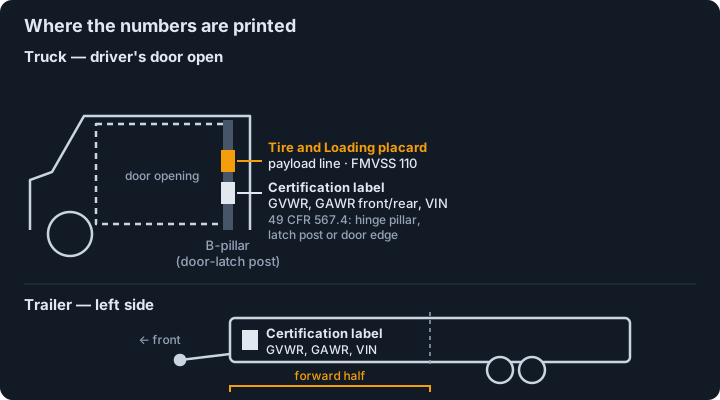
1. Take the trailer's GVWR, not its dry weight. It is on the trailer's own certification label on the forward half of the left side, and usually on the spec page. This is the weight you will actually tow — see dry weight vs GVWR.
2. Multiply by 13% for a conventional trailer to get planning tongue weight. Use 20% for a fifth wheel.
3. Add what else the truck carries. People, gear in the cab and bed, and the hitch itself: a weight distribution hitch's weight is on the maker's product listing, and it is not trivial.
4. Compare with the payload on YOUR truck's door label. The yellow tire and loading placard, the line reading "The combined weight of occupants and cargo should never exceed...". Not a brochure figure, not a review, not the model's best configuration — the label on the vehicle you are going to drive home.
If the label figure is smaller than the answer, the trailer is not half-ton towable by your half-ton, whatever the brochure says. Run it through Can I Tow This? if you would rather it did the arithmetic.
The Check, Run on Real Trailers
Six current travel trailers, each figure from that floorplan's own manufacturer page. Payload needed uses stated assumptions, not measurements: a family of four at 600 lb, 200 lb of gear, and a weight distribution hitch assumed at 90 lb — 890 lb aboard before the trailer is even attached. Substitute your own figures.
| Trailer | GVWR | Tongue at 13% | Payload needed |
|---|---|---|---|
| Grand Design Imagine XLS 17MKE | 6,395 lb | 831 lb | 1,721 lb |
| Jayco Jay Feather 21MML | 6,500 lb | 845 lb | 1,735 lb |
| Grand Design Imagine XLS 22MLE | 6,995 lb | 909 lb | 1,799 lb |
| Jayco Jay Feather 23RK | 7,400 lb | 962 lb | 1,852 lb |
| Grand Design Imagine XLS 25DBE | 7,995 lb | 1,039 lb | 1,929 lb |
| Jayco Jay Feather 27BH | 8,200 lb | 1,066 lb | 1,956 lb |
Now against real published half-ton payloads from our truck database:
| Half-ton configuration | Payload | Trailers above it can take |
|---|---|---|
| F-150 2.7L EcoBoost (13th gen) | 1,690 lb | none of the six |
| F-150 2.7L EcoBoost (2025) | 1,775 lb | 2 of 6 |
| F-150 3.5L PowerBoost hybrid (2025) | 1,815 lb | 3 of 6 |
| Chevrolet Silverado 1500 6.2L V8 | 2,030 lb | all 6 |
| F-150 3.5L EcoBoost (2025) | 2,440 lb | all 6 |
Both of the trailers Grand Design markets under a "Half-Ton Towable" heading — the 22MLE at 6,995 lb and the 25DBE at 7,995 lb — need 1,799 lb and 1,929 lb of payload with a family aboard. Two of these five real half-ton configurations cannot carry the 22MLE, and three cannot carry the 25DBE.
The claim is not a lie. It is just answered by a different truck than the one in your driveway.
Why Two Identical-Looking Trucks Differ by Hundreds of Pounds
Payload is what is left after the truck's own weight, so anything that makes the truck heavier makes the payload smaller. Between two trucks with the same badge and the same tow rating:
- Four-wheel drive adds weight over two-wheel drive.
- A crew cab adds weight over an extended or regular cab.
- A larger engine — and a hybrid battery in particular — adds weight.
- Options add up quietly: sunroof, air suspension, running boards, larger wheels, a heavier trim's sound deadening.
- Anything fitted after the factory — a hard tonneau, a toolbox, a steel bumper, a bed liner — is not in the door-label figure at all. You subtract it yourself.
This is why the configuration behind a model's best published payload is not necessarily the one on the lot, and why a truck that reviews well for towing may still be the wrong specific truck. The truck payload guide covers what removes it, and the truck class comparison shows how far the spread runs.
Questions to Ask Before You Sign
Six questions. Each closes a gap the brochure leaves open.
- "What is this trailer's GVWR?" If the answer is a dry weight, ask again.
- "Can I see the weight label on this actual unit?" Forward half of the left side. Many makers weigh each unit and label it individually, and that label beats any printed figure.
- "What options are on this one, and are they in that weight?" Dealer-installed accessories are explicitly outside the published dry figure.
- "What is the loaded tongue weight, not the dry hitch weight?" The published figure is measured empty.
- "Half-ton towable with what payload?" A fair question: the phrase does not name a truck or a payload, so ask which one the claim was checked against.
- "May I see the door label on my own truck?" — this one you ask yourself, in the car park, before you commit.
If the numbers do not work, the options are a lighter trailer, a truck with more payload, or leaving people and gear behind. Those are the only three, and the arithmetic does not negotiate. The capacity ladder shows what each rating realistically buys.
Frequently asked questions
Does half-ton towable mean my half-ton can tow it?
Not necessarily. The phrase means the trailer falls within the tow rating of some half-ton pickup, and it is usually anchored to the trailer's dry weight. Your truck's limit is more often payload than tow rating, and half-ton payload varies from about 1,405 to 3,315 lb depending on configuration. Check the trailer's GVWR against the payload figure on your own door label before treating the claim as an answer.
How do I check if a trailer is really half-ton towable for my truck?
Take the trailer's GVWR, multiply by 13% for planning tongue weight, then add your passengers, your gear and the hitch hardware (its weight is on the hitch maker's listing). Compare that total against the payload printed on the yellow placard in your driver's door area. If the label figure is lower, the trailer is beyond that truck regardless of what the marketing says.
Is half-ton towable a regulated term?
No. It is marketing language with no standard definition and no legal force. Nothing requires a manufacturer to state which half-ton it has in mind, what payload that truck has, or whether the claim refers to dry weight or GVWR. The binding numbers are the trailer's GVWR on its certification label and the payload on your tow vehicle's placard.
What payload do I need for a 7,000 lb travel trailer?
Roughly 1,800 lb with a family aboard. A 7,000 lb loaded trailer puts about 910 lb on the hitch at 13%, and four people plus gear plus a weight distribution hitch (using this guide's assumed figures) adds around 890 lb more. In our database, 18 of the 47 half-ton configurations publish less than 1,800 lb of maximum payload, and an optioned truck's door label is often lower than its configuration's maximum, which is why the check matters even for a trailer well inside the tow rating.
Why do dealers use the phrase if it does not mean much?
Because it is true of the trailer and it answers the question buyers ask, which is whether they need a bigger truck. It is not deceptive so much as incomplete — it addresses tow rating, which is the number people know, rather than payload, which is the number that usually binds. Treat it as a signal that the trailer is in the lighter half of the market, then do the payload check yourself.

