Highway Safety
What Is Trailer Sway? Causes, Recovery and Prevention


On this page9 sections
What Trailer Sway Is and Why It Escalates
What is Trailer Sway: Trailer sway is a side-to-side swinging of the trailer about the hitch ball, which in turn pushes the back of the tow vehicle from side to side.
A small disturbance usually dies out after a swing or two. Above a certain speed, which depends on how the rig is loaded and set up, it may not: each swing can be as large as the last or larger. Severe sway can end in a lane departure, a jackknife or a rollover.
Most of what decides whether sway dies out is set before the trip: tongue weight percentage, where heavy cargo sits, tire pressures, hitch setup and speed. The quickest check is your tongue weight as a share of loaded trailer weight, which the Trailer Tongue Weight Calculator works out.
Center of Gravity and Yaw: Why Sway Builds
Think of the trailer as a weather vane pivoting on the hitch ball. When something pushes its tail sideways, its tires generate a side force that steers it back toward straight behind the tow vehicle. Whether that return is smooth or overshoots back and forth depends on a few properties of the rig:
- Tongue weight. Positive tongue weight means the trailer's center of gravity sits ahead of its axles. The further ahead it sits (roughly 10-15% of the weight on the tongue), the better the trailer settles after a disturbance. With too little tongue weight the center of gravity is close to the axles, the restoring effect is weak, and the swinging is slow to die out. If the center of gravity ever moves behind the axles, tongue weight goes negative and the coupler tries to lift off the ball.
- Where the mass is. Heavy items at the far front and back of the trailer raise its resistance to rotation (yaw inertia), so once it starts swinging it carries more momentum through each swing. Heavy items near the axles do the opposite.
- Speed. Every combination has a speed above which disturbances stop dying out. It is lower for a badly loaded rig than a well loaded one, which is why sway often appears only once you speed up.
- Tow-vehicle rear tires and hitch overhang. Soft or underinflated rear tires, an overloaded rear axle and a long distance from the rear axle to the ball all make it easier for the trailer to steer the tow vehicle.
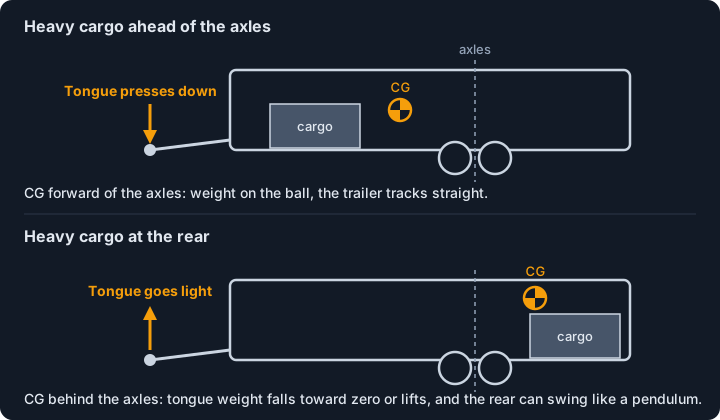
None of these has a published threshold you can read off a label, but every one of them can be checked: the tongue percentage with a scale, the load placement by looking, the tire pressures against the placard, and the rear axle load against its GAWR. The Towing Payload Calculator covers the axle and payload side.
Check Your Tongue Weight Percentage
Too little tongue weight is a common loading cause of trailer sway, and one you can measure. Enter your loaded trailer weight and measured tongue weight to see where you sit against the common 10–15% guideline for a bumper-pull trailer.
Try it
Tongue weight percentage check
For a bumper-pull trailer the common guideline is 10–15% of the loaded trailer weight on the ball. Use weights from a scale or a tongue-weight scale, not the brochure.
Enter both weights to see the percentage.
Speed, crosswinds, passing trucks and a worn or mis-adjusted hitch all add to sway, and no calculator can score them. If the trailer starts to sway, follow the procedure in your vehicle and brake controller manuals.
What Triggers Sway: Passing Trucks, Crosswinds and Speed
A well-set-up trailer can still be disturbed. The usual triggers are:
Being passed by a large vehicle.
A truck or bus pushes air aside as it goes by. As its front, its side and then its tail pass the trailer, the air pressure on the trailer's side changes, so the trailer gets a brief sideways push and then a pull. The forces last a second or two, but on a tall, flat-sided trailer they are enough to start a swing if the rig is already near its stability limit.
Crosswinds and gusts.
Wind acts on the trailer's whole side area, which is usually far larger than the tow vehicle's. Gusts, and gaps between buildings, cuttings or trees, give sudden changes in side force.
Speed.
Aerodynamic side forces grow with the square of speed: going from 50 to 70 mph roughly doubles them, since (70/50)2 ≈ 1.96. Higher speed also brings the rig closer to the point where swings stop dying out. Some states set lower speed limits for vehicles towing trailers; check the rules for your route in the state towing laws hub.
- Abrupt steering or braking. A sudden lane change or a hard stab of the brakes can start a swing on its own.
Key terms: sway and stability
Terms used when discussing sway and lateral stability:
- Critical speed: The speed above which a disturbance no longer dies out on its own. Low tongue weight, heavy items at the ends of the trailer, soft rear tires and a long hitch overhang all lower it.
- Yaw and yaw rate: Yaw is rotation about a vertical axis; yaw rate is how fast it happens. Electronic trailer sway control in modern tow vehicles watches the vehicle's yaw rate for the repeating pattern sway produces.
- Yaw inertia: A body's resistance to starting or stopping rotation about a vertical axis. Mass far from the trailer's axles raises it.
- Trailer sway control (electronic): A feature of the tow vehicle's stability control that detects sway and responds by braking individual wheels and reducing engine power, and on some vehicles by applying the trailer brakes. What it does differs by manufacturer; the owner's manual describes yours.
- Pivot projection: A hitch geometry that uses linkages to move the effective pivot point forward toward the tow vehicle's rear axle, shortening the lever the trailer has to steer the tow vehicle.
What to Do When the Trailer Starts to Sway
If your rig begins to fishtail at highway speed, your natural driving instincts may tell you to brake hard or steer aggressively in the opposite direction. Those inputs can make some sway events worse.
Hard braking can slow the tow vehicle faster than the trailer, and sharp steering can add energy to the oscillation. The safer goal is to keep the rig straight, reduce speed smoothly, and let the trailer settle.
What the manufacturers actually publish. Three independent sources — General Motors, Ford and Jayco — give the same procedure, and it is shorter than most advice you will read:
- Ease off the accelerator, gradually. GM: "reduce vehicle speed by gradually removing your foot from the accelerator." Jayco: "gradually release the accelerator."
- Keep steering inputs small. Jayco: "minimize steering adjustments to avoid exacerbating sway." GM warns against steering or braking suddenly.
- Stop and find the cause. This is the step people skip. GM lists what to check: an improperly loaded or overloaded trailer, unrestrained cargo, an improper hitch configuration, or incorrect tyre pressures. Ford says to stop as soon as it is safe and check the tongue weight and load distribution.
On using the brake controller's manual lever, manufacturers disagree. Redarc, which builds controllers, describes its lever as designed for "correcting trailer 'sway' whilst traveling." Ford's F-150 manual names that same practice as misuse: "Misuse, such as application during trailer sway, could cause instability of trailer or tow vehicle" — because the controller "does not provide anti-lock control of the trailer wheels," so a manual application can lock one. GM permits the lever for "additional trailer braking at any time" but does not name sway.
Given a live disagreement between a vehicle manufacturer and a component manufacturer, the defensible position is to follow the manual for the vehicle you are driving. What all of them agree on is the accelerator, the steering and the stop.
Sway Prevention: Friction vs. Pivot-Projection Hitches
Sway control hardware reduces sway; it does not fix a badly loaded trailer. Get the tongue percentage and load placement right first, then choose hardware that matches the trailer, the tow vehicle and the owner's manual:
Friction sway control:
A bar between the trailer frame and the hitch with a friction pad that resists the trailer pivoting. It is inexpensive. Follow the maker's instructions on when it must be disconnected; reversing is one case.
Weight distribution hitches with built-in sway control:
Cam designs (for example the Reese Dual-Cam) hold the spring bars in cams that resist the trailer turning away from straight; integrated friction designs (for example the Equal-i-zer) resist it with friction at the bar brackets and hitch head. Both also distribute tongue weight.
Pivot-projection hitches:
Hitches such as the Hensley Arrow and ProPride 3P use linkages to move the effective pivot point forward toward the tow vehicle's rear axle, so the trailer has much less leverage to steer the tow vehicle. They are the most expensive and heaviest option, and their weight counts against payload. Check the combination's totals in the GCWR Towing Calculator.
Worked example (hypothetical): sway started by a passing vehicle
This is a hypothetical example built to show the method. The vehicle, trailer and every number below are illustrative; they are not a reader's trip or a measured result. Replace each line with your own door label and scale weights.
Picture a twin-axle toy hauler at 68 mph being overtaken by a bus. As described in the triggers section above, the changing air pressure as the bus goes by gives the trailer a brief sideways push and then a pull. That is enough to start a swing.
What changes the outcome is set before the trip:
- Speed. Side forces rise with the square of speed, so (68/55)2 ≈ 1.53. At 68 mph the same disturbance carries roughly 50% more side force than at 55 mph.
- Tongue weight. A trailer loaded inside the 10 to 15% band recovers more readily than a tail-heavy one.
- Sway control. A friction, cam or pivot-projection hitch, covered above, resists the oscillation before the driver has to.
If sway does start, the published manufacturer procedure in the section above applies: ease off the accelerator gradually, keep steering inputs small, and once stopped safely, find the cause (load, hitch setup, tire pressures). As noted there, no manufacturer manual consulted for this guide publishes a separate technique for being passed, and manufacturers disagree about using the brake controller's manual lever during sway. Follow the manual for the vehicle you are driving.
Frequently asked questions
Why does driving faster make trailer sway so much worse?
Two reasons. Aerodynamic side forces on the trailer grow with the square of speed, so at 70 mph they are nearly double what they are at 50 mph. And every rig has a critical speed above which a swing no longer dies out on its own; the faster you go, the closer you are to it. Slowing down gradually, without hard braking, is the first step every manufacturer procedure in this guide gives.
Should I turn off my vehicle's electronic sway control system when using a sway hitch?
Generally no; follow your owner's manual. Many current trucks and SUVs include trailer sway control as part of electronic stability control. It watches for the yaw pattern sway produces and responds by braking individual wheels and cutting engine power, and some systems also apply the trailer brakes. It works alongside a sway-control hitch rather than replacing it, and manuals describe it as an aid that cannot prevent sway in every situation.
Can towing an unlevel trailer trigger sway?
It can contribute. A trailer towed nose-high tilts its weight rearward, which reduces tongue weight somewhat, and on a tandem-axle trailer it puts more load on the rear axle than the front. Neither effect is large for a small tilt, but both push in the wrong direction. Choose a ball mount drop or rise that leaves the trailer frame level when hitched (with weight distribution bars tensioned, if fitted), then confirm the tongue percentage on a scale.


