Payload
Does Tongue Weight Count as Payload? Yes — Here Is the Math


On this page6 sections
The Short Answer
Yes. All of it, every pound.
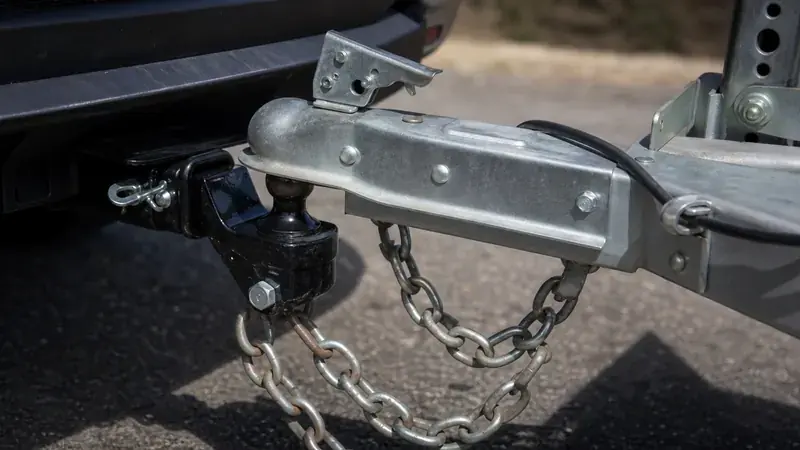
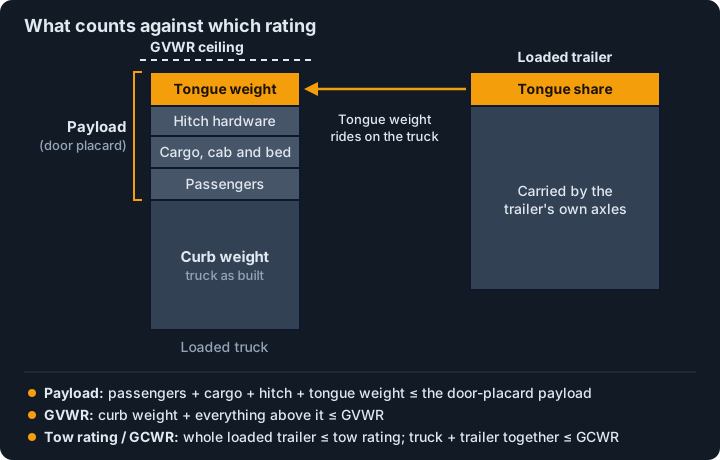
Payload is the weight your vehicle may carry. Tongue weight is weight your vehicle carries — it presses down on a hitch that is bolted to the frame. So it comes out of the same allowance as your passengers, your dog, the cooler and the firewood.
This is not an interpretation. 49 CFR 575.6(a)(5) requires the owner's manual of vehicles rated at 10,000 lb GVWR or less (built on or after September 1, 2005) to carry this sentence verbatim, as a step in determining the load limit:
"If your vehicle will be towing a trailer, load from your trailer will be transferred to your vehicle. Consult this manual to determine how this reduces the available cargo and luggage load capacity of your vehicle."
The federal tire-selection standard, FMVSS 110 (49 CFR 571.110), S9.3.4, puts it even more plainly on the capacity label required for motor homes, which must state that "the tongue weight of a towed trailer counts as cargo." That specific wording is mandated for motor homes rather than for pickups, but the physics is identical for anything with a ball on the back.
So the place to look in your own manual is the loading chapter, where that sentence appears, and the towing chapter, which gives the vehicle's tongue-weight limits.
A Three-Line Example
Worked example (hypothetical). A crew cab with 1,775 lb of payload on its door label (the published maximum for a 2025 F-150 2.7L in our database), towing a 7,000 lb trailer. The people, gear and hitch weights are assumptions; replace them with your own.
| Line | Weight | Payload left |
|---|---|---|
| Starting payload (door label) | 1,775 lb | 1,775 lb |
| Four people at an assumed 150 lb | −600 lb | 1,175 lb |
| Gear in the cab and bed (assumed) | −200 lb | 975 lb |
| Weight distribution hitch (assumed; check the maker's listing) | −90 lb | 885 lb |
| Tongue weight, 7,000 lb trailer at 13% | −910 lb | −25 lb |
The truck is 25 lb over its payload rating, and nobody overpacked. The trailer is well inside that truck's tow rating. The tongue weight alone consumed more payload than the entire family.
Nothing in that example is extreme, and it is why the tow rating on the window sticker is so often the wrong number to plan with. Work your own figures in the payload calculator.
Does a Weight Distribution Hitch Get Rid of It?
No, although this is a common misunderstanding.
A weight distribution hitch uses spring bars to apply leverage at the hitch head. That leverage takes part of the load off the tow vehicle's rear axle and returns it to the front axle and to the trailer's own axles. It changes where the weight sits.
What it does not change:
- The total. The trailer still presses down with the same tongue weight, and the truck still carries what it carries.
- Any rating. GVWR, payload and the axle ratings are unchanged. Nothing bolted on alters a certified figure.
- The payload arithmetic. You still subtract the full tongue weight, and then you subtract the hitch hardware too. The head and spring bars are payload; their weight is on the hitch maker's product listing.
What it genuinely fixes is axle distribution: a rear axle over its GAWR can come back under it, and steering weight lost to the lever effect can be restored. Both are worth having. Neither is extra capacity. See the weight distribution hitch guide.
Fifth Wheels and Goosenecks Are Worse
A fifth wheel or gooseneck typically puts 15 to 25% of loaded trailer weight on the truck (a commonly used guideline) instead of the 10 to 15% a conventional trailer puts on the ball, and it lands in the bed, over or just ahead of the rear axle rather than behind it.
All of it is payload. A 12,000 lb fifth wheel at 20% is 2,400 lb of pin weight — before the fifth-wheel hitch itself, which is considerably heavier than a ball mount (its weight is on the hitch maker's listing), and before anyone gets in the truck. The trailer maker's spec sheet gives a dry pin weight; it rises as the trailer is loaded.
That single figure is why fifth-wheel shopping is a payload exercise from the first minute, and why a truck that tows a 12,000 lb travel trailer without complaint may be entirely wrong for a 12,000 lb fifth wheel. The arithmetic is worked through in payload needed for a fifth wheel.
Where to Find Your Real Numbers
Two labels and one scale settle it.
Payload is on the yellow tire and loading information placard in the driver's door area, on the line that reads "The combined weight of occupants and cargo should never exceed...". That figure already accounts for the options fitted at the factory, and it does not account for anything added since — see how to read a towing sticker.
Tongue weight you can estimate at 13% of the trailer's loaded weight for planning, but measuring beats estimating — the methods are in how to calculate tongue weight.
The scale is what proves it. A loaded pass over a truck-stop scale gives you axle weights to compare against the ratings, and it is the only way to see a rear axle that is over its own limit while total weight still looks fine. That failure mode is covered in GAWR vs GVWR.
Frequently asked questions
Does tongue weight count against payload or against towing capacity?
Against payload. Towing capacity limits the weight of the trailer behind the vehicle; payload limits what the vehicle itself carries, and the tongue presses down on a hitch bolted to the vehicle. This is why a trailer can sit comfortably inside a tow rating while the setup is over its payload limit — the two ratings measure different things and both have to pass.
Does a weight distribution hitch reduce tongue weight?
No. It redistributes the load already there, moving some of it from the tow vehicle's rear axle onto its front axle and the trailer's axles. The total tongue weight is unchanged, no rating changes, and you still subtract the full tongue weight from payload. The hitch hardware itself is additional payload on top; take its weight from the hitch maker's listing.
Does pin weight on a fifth wheel count as payload?
Yes, entirely, and it is a larger share than a conventional trailer's tongue weight — commonly 15 to 25% of loaded trailer weight rather than 10 to 15%. It also lands in the bed rather than behind the rear axle. A 12,000 lb fifth wheel at 20% puts 2,400 lb into the truck before the hitch hardware and before any passengers.
Is the tongue weight on the trailer's spec sheet the figure I should use?
Only as a starting point. Published hitch or tongue weight is measured at the trailer's dry weight, so it rises once the trailer is loaded with water, propane, gear and cargo. For planning, use 13% of the trailer's loaded weight — or its GVWR if you do not know the loaded weight — and then measure the real figure before a long trip.
Continue reading
- Payload/13 min readCan You Increase Payload Capacity? Airbags, Springs and the Sticker
- Towing Basics/15 min readGAWR vs GVWR: Axle Ratings, Front/Rear, and Why the Sum Is Not the GVWR
- Towing Physics/22 min readPayload vs. Towing Capacity: Why Payload Can Run Out First

- Towing Mathematics/14 min readHow to Calculate Tongue Weight: Bumper-Pulls & 5th Wheel Pins