Buyer's Guide
Half-Ton vs 3/4-Ton vs 1-Ton: Which Truck Class Do You Need?


On this page9 sections
Fast Answer: Choose by Payload, Not by Tow Rating
Pick the class that carries your tongue or pin weight, not the one that pulls your trailer weight. Nearly every buyer gets this backwards, because tow rating is the number on the window sticker and payload is not.
The short version:
- Midsize tow ratings in our database run from 4,000 lb (the compact Maverick) to 7,700 lb, which suits small campers, utility trailers and light boats once you plan below the rating.
- Half-ton suits most single-axle and smaller tandem-axle travel trailers, with the payload check typically getting tight somewhere around 7,000–8,000 lb of trailer GVWR (worked below) — but the spread inside this class is enormous, and a badly chosen half-ton is weaker than a well chosen midsize.
- Three-quarter-ton is the entry point for fifth wheels and for anyone towing heavy regularly.
- One-ton, particularly with dual rear wheels, is for large fifth wheels, goosenecks and commercial loads.
The single most useful thing to know before shopping: "half-ton" tells you almost nothing about what a specific truck can carry. Across the 47 half-ton configurations in our database, published payload spans 1,405 to 3,315 lb, and the weakest half-tons publish less payload than the best midsize trucks (1,710 lb).
Check the payload on the actual truck's door label — see how to read a towing sticker — then run your setup through Can I Tow This?
What the Class Names Actually Mean
Half-ton, three-quarter-ton and one-ton were payload descriptions once. A half-ton truck carried about 1,000 lb. They stopped being literal decades ago: a modern half-ton can carry three times that, and a well-optioned one can carry less than a midsize.
What the names survive as is a rough chassis class, and the useful modern equivalent is the manufacturer's GVWR:
| Nickname | Typical badge | GVWR range in our database |
|---|---|---|
| Midsize and compact | Tacoma, Ranger, Colorado, Canyon, Frontier, Gladiator, Maverick | 5,080–6,250 lb |
| Half-ton | F-150, Silverado 1500, Sierra 1500, Ram 1500, Tundra, Titan | 6,500–8,990 lb |
| Three-quarter-ton | F-250, Silverado 2500HD, Sierra 2500HD, Ram 2500 | 10,000 lb |
| One-ton | F-350, Silverado 3500HD, Sierra 3500HD, Ram 3500 | 11,500–14,000 lb |
Notice the three-quarter-ton row. Every configuration in that class sits at exactly 10,000 lb GVWR, which is not a coincidence — it is the top of the light-duty band, and staying at or under it keeps a truck clear of a set of heavier-vehicle rules. That is why the jump from a 2500 to a 3500 is a bigger change on paper than the badge suggests.
The Real Rating Ranges
These are the published figures across all 78 configurations in the site's truck database. Ranges, not averages — because the range is the point.
| Class | Tow rating | Payload | GCWR | Configs |
|---|---|---|---|---|
| Midsize and compact | 4,000–7,700 lb | 1,150–1,710 lb | 8,145–13,250 lb | 17 |
| Half-ton | 6,800–14,000 lb | 1,405–3,315 lb | 12,900–19,500 lb | 47 |
| Three-quarter-ton | 15,000–22,000 lb | 3,160–4,050 lb | 21,500–30,000 lb | 9 |
| One-ton | 24,000–38,000 lb | 4,430–7,650 lb | 31,000–43,500 lb | 5 |
Two things stand out.
The half-ton class overlaps everything. Its weakest configuration tows 6,800 lb — less than the strongest midsize at 7,700 lb. Its strongest tows 14,000 lb, closing on a three-quarter-ton. Buying "a half-ton" is not a decision; buying a particular half-ton is.
Payload does not track tow rating. The half-ton class carries between 1,405 and 3,315 lb, and the configuration with the highest tow rating is frequently not the one with the highest payload. Heavy-duty payload packages, cab and bed choices, four-wheel drive and options all move payload independently of what the powertrain can pull. Our truck payload guide covers what removes it.
Where Each Class Actually Runs Out
Payload is what carries tongue weight, so payload is what sets the largest trailer a truck can take. Using the site's own planning figures — 600 lb of people and gear aboard, tongue weight at 13% of loaded trailer weight for a conventional trailer, and 20% pin weight for a fifth wheel — the classes land like this:
| Class | Conventional trailer supported | Fifth wheel supported |
|---|---|---|
| Midsize | 4,231–8,538 lb | 2,750–5,550 lb |
| Half-ton | 6,192–20,885 lb | 4,025–13,575 lb |
| Three-quarter-ton | 19,692–26,538 lb | 12,800–17,250 lb |
| One-ton | 29,462–54,231 lb | 19,150–35,250 lb |
Read the fifth-wheel column carefully. A pin weight of 20% instead of a tongue weight of 13% costs roughly a third of the trailer weight a given payload supports. This is why the fifth-wheel question is a different question from the travel-trailer question, and why a truck that handles a 9,000 lb travel trailer comfortably may be wrong for a 9,000 lb fifth wheel.
These are payload-only figures. The tow rating and GCWR cap them separately, which is why the top of several ranges is far above any tow rating in the class: a one-ton's payload could carry the tongue of a 54,000 lb trailer, but no one-ton in the database is rated to tow more than 38,000 lb. Use the lower of the two.
They also assume only 600 lb aboard. Add a weight distribution hitch and a real load of gear and every number drops — the mechanism is worked through in how to calculate towing capacity.
When a Half-Ton Stops Working
Three thresholds, in the order most buyers meet them.
Around 7,000–8,000 lb of trailer GVWR on a conventional trailer. At 8,000 lb the tongue weight is roughly 1,040 lb at the 13% planning figure. Add four people and gear at 600 lb and the payload demand is about 1,640 lb before the hitch's own weight. In our database, 6 of the 47 half-ton configurations publish less than that, and the published figures are maximums for the lightest qualifying build: an optioned crew-cab four-wheel-drive truck's own door label is often lower. That label is the number to check.
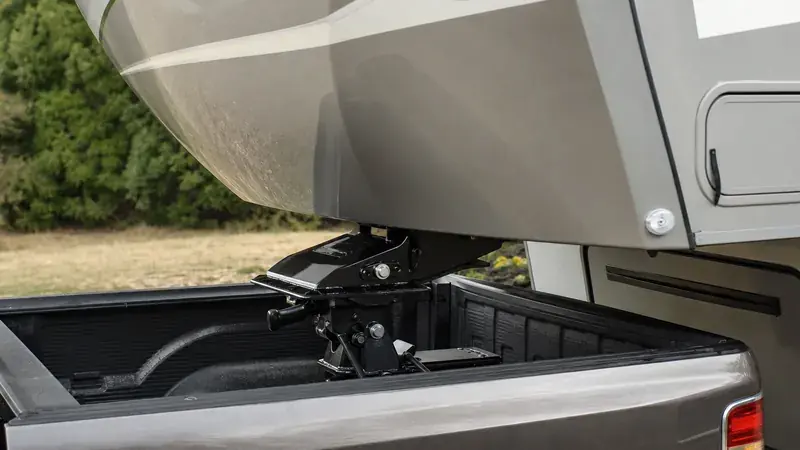
Any fifth wheel whose pin weight exceeds remaining payload. A commonly quoted range for pin weight is 15–25% of loaded trailer weight; it lands in the bed rather than behind the axle, and it is pure payload. A 10,000 lb fifth wheel at 20% asks 2,000 lb before anyone gets in the truck. Add 600 lb of people and gear and you need about 2,600 lb: only two of the 47 half-ton configurations in our database publish that much (both 2021–2023 F-150s), before the fifth-wheel hitch's own weight is counted. See half-ton fifth-wheel towing.
When the rear axle runs out before the whole truck does. Payload is a whole-vehicle limit, but tongue and pin weight land at the back, so the rear GAWR can be exceeded while total weight still looks fine. That failure is invisible without a scale — see GAWR vs GVWR.
The honest summary is that a half-ton is an excellent travel-trailer truck and a poor fifth-wheel truck, and the boundary is not the tow rating printed in the brochure.
Single Rear Wheel vs Dually
Within the one-ton class the bigger decision is not the badge but the number of rear wheels. The same model illustrates it:
| Ford F-350 configuration | GVWR | Payload | Tow rating | GCWR |
|---|---|---|---|---|
| 6.7L diesel, single rear wheel | 11,500 lb | 4,430 lb | 24,000 lb | 31,000 lb |
| 6.7L HO diesel, dual rear wheel | 14,000 lb | 7,650 lb | 38,000 lb | 43,500 lb |
Same nameplate, same engine family. The dually carries 3,220 lb more payload and pulls 14,000 lb more.
Four rear tires spread the load across twice the contact patches, which raises the rear axle's usable capacity and the tire capacity beneath it. For a large fifth wheel or a gooseneck that is exactly where the load goes.
What it costs you is width, parking, tyre replacement in fours rather than twos, and a rear end that is unpleasant on narrow roads. If the pin weight fits inside an SRW one-ton's payload, an SRW is the easier truck to live with. If it does not, no amount of preference changes the arithmetic.
What Else Changes With Class
Capability is not free, and the differences that matter day to day are rarely in the brochure.
- Ride quality. Heavier springs are calibrated for load. An empty three-quarter-ton rides firmly, and an empty dually more so. If most of your driving is unladen, that matters more than the towing days.
- Fuel. Heavier-duty trucks generally use more fuel unladen, a cost you pay on every non-towing day.
- Size. Three-quarter-ton and one-ton trucks are longer, taller and wider. Height matters in car parks; dually width matters in lanes and drive-throughs.
- Cost of ownership. Larger tyres, larger brakes, more oil, and on a dually six tyres rather than four.
- Registration, tolls and licensing. These vary by state and by loaded weight rather than by badge, and heavier combinations can cross thresholds lighter ones do not. Check your own state rather than assuming, and note that a very heavy combination can reach the point where a non-commercial licence class is required.
None of this argues against buying the bigger truck. It argues for buying the right one: the cheapest truck that carries your pin or tongue weight with margin is usually the best truck to own.
Decision Table by What You Tow
| What you tow | Class that fits | The limit to check first |
|---|---|---|
| Utility trailer, small boat, teardrop under 3,500 lb | Midsize | Tow rating and hitch rating |
| Travel trailer to about 6,000 lb GVWR | Midsize at the top of its range, or any half-ton | Payload after passengers |
| Travel trailer 6,000–8,000 lb GVWR | Half-ton with a payload above roughly 1,700 lb | Payload, then rear GAWR |
| Travel trailer above 8,000 lb GVWR | Strong half-ton or three-quarter-ton | Payload, then GCWR |
| Fifth wheel under about 10,000 lb GVWR | Three-quarter-ton | Pin weight against payload |
| Fifth wheel 10,000–15,000 lb GVWR | One-ton, SRW usually sufficient | Pin weight and rear GAWR |
| Fifth wheel or gooseneck above 15,000 lb GVWR | One-ton dually | Pin weight, rear GAWR, licence class |
| Horse trailer, three or more horses | Three-quarter-ton or one-ton | Payload, and live-load stability |
Work the specific numbers rather than the row: take the trailer's GVWR, convert it to tongue or pin weight, and check it against the payload on the door label of the truck you are actually considering. The capacity ladder does that conversion for every rating from 3,500 to 15,000 lb, and the truck database holds the per-configuration figures behind the ranges on this page.
Frequently asked questions
How much can a half-ton truck tow?
Across the configurations in our database, half-ton tow ratings run from 6,800 to 14,000 lb — a range so wide that the class name is not a useful answer on its own. The more useful figure is payload, which runs from 1,405 to 3,315 lb in the same class. For a conventional trailer with 600 lb of people and gear aboard, that payload supports somewhere between about 6,200 and 20,900 lb of loaded trailer before the tow rating caps it. Those are published maximums for specific configurations; an optioned truck's own door label is often lower, and that label is the figure to plan with.
How much can a 3/4-ton truck tow?
Three-quarter-ton tow ratings in our database run from 15,000 to 22,000 lb with payloads between 3,160 and 4,050 lb. Every configuration sits at a 10,000 lb GVWR, which is the top of the light-duty band. In practice that payload supports a fifth wheel of roughly 12,800 to 17,250 lb at a 20% pin weight, which is why the three-quarter-ton is the usual entry point for fifth-wheel towing.
Do I need a 1-ton truck for a fifth wheel?
Not always. On the payloads in our database, a three-quarter-ton can carry the pin weight of most fifth wheels under about 10,000 lb GVWR. The deciding number is pin weight against remaining payload: pin weight is commonly quoted at 15-25% of loaded trailer weight, it lands in the bed, and it is pure payload. Work out the pin weight for the specific trailer, subtract your passengers, gear and the hitch itself from the truck's door-label payload, and see whether what is left covers it. If it does not, move up a class rather than hoping.
Is a half-ton enough for a travel trailer?
For many travel trailers, yes. The payload check usually gets tight around 7,000 to 8,000 lb of trailer GVWR: at 8,000 lb, a 13% tongue weight plus 600 lb of family and gear demands about 1,640 lb of payload before the hitch's own weight. Above that you need one of the stronger half-ton configurations or a three-quarter-ton. Below it, a half-ton is the more comfortable truck to own for everything else you do with it.
What is the difference between SRW and dually?
Dual rear wheels spread the rear load across four tyres instead of two, which raises usable rear axle and tyre capacity. On the same Ford F-350 platform the single-rear-wheel diesel carries 4,430 lb of payload with an 11,500 lb GVWR, while the dual-rear-wheel version carries 7,650 lb with a 14,000 lb GVWR — 3,220 lb more payload. The cost is width, parking difficulty, a firmer empty ride and six tyres to replace instead of four.
Why do two half-tons have such different payloads?
Because payload is what is left after the truck's own weight, and configuration changes that weight a great deal. Four-wheel drive, a crew cab, a sunroof, a larger engine, air suspension and running boards all add weight and all subtract from payload. A heavy-duty payload package moves it the other way. Two trucks with the same badge and the same tow rating can differ by hundreds of pounds of payload, which is why the door label on the specific vehicle is the only figure worth planning against.
Is a 3/4-ton much worse to drive than a half-ton?
Unloaded, it is usually firmer. Heavier springs calibrated for load make the ride stiffer when the bed is empty, the truck is larger in every dimension, and fuel consumption is higher. Loaded, the same trailer is a smaller share of what the heavier truck is rated for, which leaves more margin on payload and axle ratings. Choose based on how much of your driving is towing.
Does moving up a class raise my tow rating enough to matter?
Usually far more than enough, but that is rarely the reason to move up. In our database the median published payload rises from about 1,930 lb for a half-ton to about 3,530 lb for a three-quarter-ton, and payload is usually the limit that was actually stopping you. If your tow rating was comfortable and your payload was not — the normal situation — then the class change buys you exactly the thing you were short of.
Continue reading
- Towing Basics/16 min readWhat Can I Tow With My Towing Capacity? The 3,500 to 15,000 lb Ladder
- Towing Physics/22 min readPayload vs. Towing Capacity: Why Payload Can Run Out First
- Truck Capability/17 min readCan Half-Ton Trucks Tow Fifth Wheels? Pin Weight and Payload