Can a Kia Sportage Tow a Small RV? The Complete Weight & Physics Analysis

🧭

TowCapacityCalc Editorial Team✓ Verified Specialist

Editorial Review Team

📅 May 30, 2026â€ĸâąī¸ 16 min read
Can a Kia Sportage Tow a Small RV - The Kia Sportage is a stylish, highly capable compact crossover, but can it tow a small RV? We break down the mechanical engineering constraints of the Sportage's 2,500-lb towing capacity, including unibody suspension limits, engine thermal performance, and payload mathematics to determine what you can safely tow.

Towing a Small RV with a Crossover: The Mechanical Boundaries

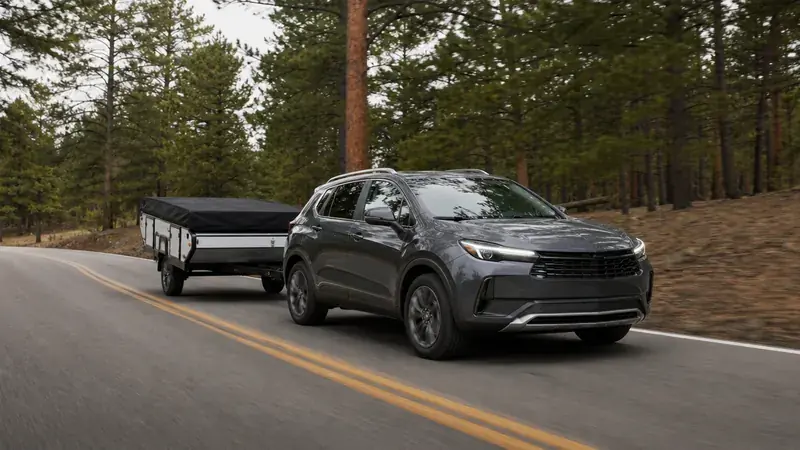
Can a Kia Sportage Tow a Small RV: Compact crossover SUVs like the Kia Sportage are excellent daily drivers, offering high fuel efficiency, premium cabin comfort, and modern safety tech. However, when owners decide to explore the RV lifestyle, they often face a rude awakening regarding their vehicle's real-world towing capability. The idea of hitching a 'small RV' or 'micro-camper' and heading into the mountains is incredibly appealing. But 'small' is a relative term in the RV industry. Even a tiny teardrop trailer or ultra-lightweight travel trailer can quickly exceed the structural and thermal limits of a compact crossover. Kia Sportage Towing Specifications (2023–2026): * Sportage 2.5L Gas (FWD/AWD): 2,500 lbs maximum towing capacity (only when equipped with trailer brakes) * Sportage 2.5L Gas (without trailer brakes): 1,653 lbs maximum towing capacity * Sportage Hybrid (1.6T HEV, FWD/AWD): 2,000 lbs maximum towing capacity (with trailer brakes) * Sportage Plug-In Hybrid (1.6T PHEV, AWD): 2,000 lbs maximum towing capacity (with trailer brakes) These specifications instantly highlight two critical engineering points: 1. Trailer brakes are mandatory to unlock the Sportage's maximum 2,000 to 2,500-lb rating. Without trailer brakes, you are legally and mechanically capped at a mere 1,653 lbs. 2. The drivetrain matters significantly. The standard naturally aspirated 2.5L gas engine with AWD provides the highest rating at 2,500 lbs, whereas the high-tech Hybrid and PHEV models are limited to 2,000 lbs due to the thermal overhead and cooling requirements of the high-voltage battery system. Understanding these mechanical boundaries is essential to prevent costly transmission failures, dangerous trailer sway, or severe suspension damage. Run your setup's numbers in our GCWR Towing Calculator to ensure compliance.

The Unibody Challenge: Crossover Suspension vs. Heavy Tongue Weights

Unlike body-on-frame pickup trucks or large SUVs, the Kia Sportage utilizes unibody construction (based on the Hyundai-Kia N3 platform). In a unibody vehicle, the chassis and body are integrated into a single structural unit. While this delivers exceptional crash safety, a quiet cabin, and car-like handling, it presents unique challenges for heavy load-bearing applications like towing an RV. Suspension Sag & Spring Rates: The Sportage uses independent rear suspension featuring multi-link arms and coil springs calibrated for passenger comfort. It is not designed to support high static downward loads. When you apply a trailer's tongue weight to the hitch ball, that weight acts as a lever arm extending behind the rear axle:
FORMULA Rear Axle Load Spike = Tongue Weight × (1 + Overhang / Wheelbase)
Because the rear overhang (distance from rear axle to hitch ball) on the Sportage is relatively long compared to its 108.5-inch wheelbase, every pound of tongue weight translates to approximately 1.4 pounds of load directly onto the rear axle suspension springs, while simultaneously lifting weight off the front steering axle. The Dangerous Consequences of Excessive Sag: 1. Loss of Front-Axle Steering Traction: As weight is lifted off the front wheels, steering response becomes loose and vague, particularly on wet roads or at highway speeds. 2. Rear Suspension Bottoming Out: Under high tongue load, the rear coil springs compress near their bump stops. Potholes or highway bridge transitions can cause the suspension to bottom out violently, risking control loss. 3. Severe Headlight Misalignment: The rear-low pitch angles your headlights upward into the eyes of oncoming drivers, creating a severe nighttime safety hazard. 4. Altered Suspension Geometry: Extreme squat changes the rear wheel camber and toe settings, leading to rapid uneven tire wear and reduced lateral stability. Weight-distributing hitches (WDH) are not approved for use on unibody compact crossovers like the Sportage because the integrated chassis rails cannot absorb the torsional twisting forces a WDH applies. Therefore, managing your tongue weight precisely within the Sportage's 250-lb limit is your only defense against suspension collapse. Use our Payload Calculator to check your vehicle's load distribution.

Small RV Weight Classes: What Can the Sportage Actually Pull?

To determine what you can safely hitch to your Sportage, we must categorize 'small RVs' by their real-world loaded weights. Never rely on the 'dry weight' advertised in sales brochures — dry weights exclude propane tanks, batteries, fresh water, gear, and air conditioners. Class 1 — Ultra-Lightweight Micro-Campers (Dry Weight: 800–1,300 lbs) These are compact, highly aerodynamic teardrop campers and small square-drop trailers: * nuCamp T@G: Dry weight approx. 1,269 lbs; Loaded weight approx. 1,500 lbs. ✅ Fully Compatible with all Sportage models. * Timberleaf Classic Teardrop: Dry weight approx. 1,500 lbs; Loaded approx. 1,900 lbs. ✅ Compatible with AWD gas models (requires trailer brakes). * SylvanSport GO Utility Camper: Dry weight approx. 840 lbs; Loaded approx. 1,200 lbs. ✅ Excellent Match for all trims. Class 2 — Compact 'Stand-Up' Travel Trailers (Dry Weight: 1,400–2,000 lbs) Small hard-wall trailers that allow adults to stand up inside: * Scamp 13-Foot Standard: Dry weight approx. 1,500 lbs; Loaded approx. 1,950 lbs. ✅ Compatible with AWD Sportage gas models (requires trailer brakes). * taxa Outdoors TigerMoth: Dry weight approx. 1,310 lbs; Loaded approx. 1,800 lbs. ✅ Compatible (requires trailer brakes). * Intech Sol Horizon Lite: Dry weight approx. 1,850 lbs; Loaded approx. 2,300 lbs. âš ī¸ Marginal — leaves only a 200-lb margin below the published tow limit and needs a careful payload check. Class 3 — Mid-Size Travel Trailers (Dry Weight: 2,000–3,000 lbs) * Airstream Bambi 16RB: Dry weight approx. 2,650 lbs; Loaded approx. 3,200 lbs. ❌ Incompatible. Exceeds all Sportage capacities by a wide margin. * Forest River R-Pod RP-171: Dry weight approx. 2,714 lbs; Loaded approx. 3,300 lbs. ❌ Incompatible. * Casita Spirit 16: Dry weight approx. 2,185 lbs; Loaded approx. 2,800 lbs. ❌ Incompatible. The Sportage Sweet Spot: To tow safely with a Sportage AWD, select a lightweight teardrop, A-frame folding trailer, or small fiberglass unit with a maximum loaded GVW under 1,800 lbs and a tongue weight under 200 lbs. For FWD or Hybrid models, limit loaded trailer weight to 1,500 lbs to preserve an adequate safety margin.

Payload Math: The Invisible Threat

Many drivers mistakenly believe that if their trailer is under the 2,500-lb towing limit, they are perfectly safe. However, the Sportage's payload capacity is almost always the first limit you will violate. The Sportage Payload Calculation Formula:
FORMULA Available Payload = GVWR - Curb Weight
For a typical 2024 Kia Sportage AWD, the payload capacity listed on the driver's door B-pillar sticker is approximately 1,000 lbs. Let's run a realistic family weekend camping scenario: * Driver (James): 185 lbs * Co-driver (Sarah): 145 lbs * Child (age 10): 85 lbs * Dog (Golden Retriever): 65 lbs * Camping gear in the cargo area (cooler, camp stove, fire wood): 120 lbs * Roof-rack crossbars + cargo box: 45 lbs * Total Occupied Vehicle Weight: 645 lbs Calculating Available Payload for Tongue Weight:
FORMULA 1,000 lbs - 645 lbs = 355 lbs available
If you are towing a small camper weighing 2,200 lbs loaded with a typical 12% tongue weight ratio, the trailer exerts a downward force of:
FORMULA Tongue Weight = 2,200 × 0.12 = 264 lbs
Compare this to your available payload: * 355 lbs available payload - 264 lbs tongue weight = 91 lbs remaining payload margin ✅ While this setup is technically legal, a 91-lb margin is extremely slim. If you load an extra cooler or add a second passenger, your Sportage will immediately be overloaded. This payload bottleneck is why we strongly advise against towing any trailer over 2,000 lbs with a compact crossover. Read our complete guide to master these dynamics: Payload vs Towing Capacity: The Critical Difference.

Sportage Powertrains: 2.5L Gas vs. 1.6T Hybrid Towing Dynamics

Kia offers the Sportage with two very different engine options, each exhibiting distinct driving characteristics under towing loads: 1. Standard 2.5L Naturally Aspirated 4-Cylinder Gas * Output: 187 horsepower & 178 lb-ft of torque * Transmission: 8-Speed Torque-Converter Automatic * Maximum Rating: 2,500 lbs (AWD with brakes) * Towing Behavior: This naturally aspirated engine must rev high to generate power. Under towing loads, the 8-speed transmission will frequently downshift, keeping the engine between 3,500 and 5,000 RPM on moderate highway grades. While noisy, the traditional torque-converter automatic transmission has excellent thermal durability and handles low-speed maneuvering smoothly without slipping. 2. 1.6L Turbocharged Hybrid (HEV/PHEV) * Output: 227 combined horsepower & 258 lb-ft of combined torque * Transmission: 6-Speed Automatic * Maximum Rating: 2,000 lbs (with brakes) * Towing Behavior: The hybrid powertrain is exceptionally strong at low speeds, with the electric motor providing instant torque that makes pulling away from stoplights effortless. The turbocharged engine delivers peak torque at much lower RPM than the standard 2.5L, making highway cruising far quieter. However, the Hybrid's rated capacity is lower (2,000 lbs) because towing creates massive thermal stress on both the electric motor and the high-voltage battery. Continuous heavy draw on steep mountain grades can exhaust the battery's state of charge, leaving you reliant solely on the small 1.6L turbo engine. Transmission Thermal Protection: Regardless of powertrain, compact crossover transmissions are vulnerable to overheating when towing near their limits. To protect your Sportage: * Avoid sustained speeds over 65 mph when towing. * Never use 'Eco Mode' while towing; select 'Sport Mode' or 'Smart Mode' to adjust transmission shift points and prevent torque-converter hunting. * Review our engineering breakdown: Can Towing Damage Your Transmission? Thermal Dynamics

The Definitive Glossary: Crossover & RV Towing Terminology

N3 Platform: The global mid-size vehicle platform developed by Hyundai-Kia, which forms the structural basis of the Sportage, Tucson, and Sorento. Uses hot-stamped, ultra-high-strength steel to maximize cabin rigidity while reducing overall chassis weight. Dry Weight: The manufacturer-listed weight of an RV as it rolls off the assembly line, excluding all optional accessories, propane, fresh water, battery, and dealer-installed items. Never use dry weight for trip safety planning. Wet Weight (GVW): The real-world operating weight of your trailer or RV, calculated by adding the dry weight to the actual weight of all loaded gear, fresh water, battery, propane, and personal belongings. Independent Rear Suspension (IRS): A suspension system design where each wheel on the rear axle is allowed to move vertically independently of the other. IRS provides superb ride quality and handling on passenger cars, but is far more prone to extreme camber changes and 'squat' under heavy tongue loads compared to a solid truck axle. Electric Brake Controller (Proportional): An electronic safety device installed inside the tow vehicle that monitors vehicle deceleration and applies a proportional electrical current to the trailer's electric brakes, slowing the trailer in tandem with the car. Mandatory for any Sportage tow over 1,653 lbs. Unibody Construction: A manufacturing technique where the vehicle's body, floor pan, and chassis are welded together into a single integrated safety cage. Contrast with 'Body-on-Frame' construction, where a separate body sits atop a heavy steel ladder frame.

Real-World Case Study: Sportage AWD Towing a nuCamp T@G in the Adirondacks

David and Elena M. are outdoor enthusiasts who wanted to explore the Adirondack Mountains in upstate New York with a teardrop camper. They owned a 2024 Kia Sportage X-Pro AWD (2.5L gas engine with 8-speed automatic) and purchased a 2024 nuCamp T@G teardrop trailer. Their Weight Audit: * Sportage X-Pro door sticker payload: 1,005 lbs * nuCamp T@G dry weight: 1,269 lbs * Battery, propane tank, and camping gear inside trailer: 190 lbs * Total loaded trailer weight (GTW): 1,459 lbs * Measured tongue weight (11.5% of GTW): 168 lbs Their Occupied Vehicle Payload: * David (driver): 195 lbs * Elena (passenger): 140 lbs * Gear in the cargo area: 85 lbs * Hitch hardware: 45 lbs * Total occupied load: 465 lbs * Available for tongue weight: 1,005 - 465 = 540 lbs * Actual tongue weight (168 lbs) vs. available payload (540 lbs): 372 lbs remaining margin ✅ Their Equipment Setup: * Factory-installed Kia Class II hitch receiver * Curt Echo wireless proportional trailer brake controller (configured via smartphone) * Single-axle electric trailer brakes on the T@G On the Adirondack Highway (Sustained 5-6% grades): David monitored the vehicle closely during their 350-mile trip. The standard 2.5L engine performed reliably. On the steep approach to Lake Placid, the 8-speed transmission shifted down to 4th gear, holding 4,200 RPM at a steady 55 mph. Engine coolant and transmission fluid temperatures remained completely normal. Because of the T@G's ultra-low aerodynamic profile, the Sportage experienced virtually no wind buffeting or lateral sway, even when passed by large semi-trucks. Average fuel economy while towing was 19.8 MPG, a highly respectable figure compared to the 26 MPG they normally average unloaded. David's Assessment: "The Sportage X-Pro handled the T@G well because we kept it light and low. We chose the T@G specifically because its loaded weight was under 1,500 lbs. The Curt Echo made braking feel controlled, and I would not want to pull anything larger with this vehicle."
Academic Q&A

Frequently Asked Questions

Can a Kia Sportage tow an R-Pod camper?
No. The smallest Forest River R-Pod (RP-171) has an empty dry weight of approximately 2,714 lbs. Once you add a battery, propane, fresh water, and camping gear, the actual loaded weight will likely exceed 3,300 lbs. This is significantly above the Kia Sportage's published towing limit of 2,500 lbs. Towing an R-Pod with a Sportage creates major transmission, suspension, braking, and control concerns.
Do I really need trailer brakes to tow with a Kia Sportage?
Yes. Kia's official vehicle owner's manual specifies that the Sportage's towing capacity is capped at just 1,653 lbs for any trailer without functioning trailer brakes. To legally and safely tow up to the maximum 2,000-lb (hybrid) or 2,500-lb (gas AWD) rating, your trailer must be equipped with an active electric braking system, and you must install a proportional brake controller inside the Sportage.
Can a Kia Sportage tow a Scamp trailer?
Yes, but only specific models. The fiberglass Scamp 13-foot standard trailer has an empty weight of roughly 1,500 lbs and a loaded weight of around 1,900–2,000 lbs. This is compatible with the Sportage 2.5L Gas AWD (rated for 2,500 lbs), provided the trailer has electric brakes installed. However, the larger Scamp 16-foot and 19-foot models exceed the Sportage's capacity and are not compatible.

Continue Reading — Related Safety Guides